Seoul Agropolis
Access to cultivable urban land is a rare commodity, as a result productive landscapes are taking over our streets, roofs, walls and undergrounds. These productive urban landscapes can have an impact on people that goes far beyond sustenance, from the creation of new economic opportunities, to the forging of social bonds and the rediscovery of one’s natural and cultural setting. A new type of city is emerging, one where every space and surface can have a different productive potential. In this new continuously productive city (an “agropolis”), production should only be seen as one part of a closed loop that also includes consumption and disposal / decomposition.

| Location: | Seoul, Korea |
|---|---|
| Status: | Study submitted |
| Date: | 2021 |
Towards a Continuously Productive City
Access to cultivable urban land is a rare commodity, as a result productive landscapes are taking over our streets, roofs, walls and undergrounds. These productive urban landscapes can have an impact on people that goes far beyond sustenance, from the creation of new economic opportunities, to the forging of social bonds and the rediscovery of one’s natural and cultural setting. A new type of city is emerging, one where every space and surface can have a different productive potential. In this new continuously productive city (an “agropolis”), production should only be seen as one part of a closed loop that also includes consumption and disposal / decomposition.
The Seoul Agropolis will channel Mongok’s agricultural past to create new paradigms that bring together traditional farming methods and high-tech means for agroecological urban production, both above ground, below ground and within buildings. The Seoul Agropolis will be a space for public exhibition and engagement, research and education, and economic growth, all centered on urban farming and sustainable living.
To illustrate the diverse potential of this agropolis, we looked back to Patrick Geddes’ 1909 paradigm-changing “Valley Section”, which depicted every part of the landscape as having a different productive role and value. In each landscape a culture and an economy developed from that value. We believe it’s time to create a new urban “Valley Section” that imbues every urban space, every urban surface with productive meaning and value. From farming for sustenance, health and livelihood, supporting pollinators to harvesting water and energy. This new urban valley section will be designed to close the loop from production to consumption and waste to reuse, creating recreational and commercial opportunities and bringing communities together at every step of the process.

The agropolis functions similarly to an urban “Valley Section” with different locations on the site most appropriate (due to a host of different factors) for different types of activities and productive landscapes.

The placement and form of the building is defined by its program and its relationship to its context.


The agropolis is located in an optimal location to forge meaningful relationships with organizations like the Seoul Arboretum, universities, and community groups.

The site is designed as a flexible framework, with fluidity in mind. The building’s armature provides vertical circulation through a series of smaller cores, and depending on how the building is used, the spaces are able to transform, expanding and contracting as needed.


Serbian Cultural Center
Office Ou has been engaged to developed a program brief and pre-design report for a new banquet hall and cultural centre in Mississauga, Ontario.

| Location: | Mississauga, Canada |
|---|---|
| Status: | Feasibility study ongoing |
| Date: | 2024-Present |
Office Ou has been engaged to developed a program brief and pre-design report for a new banquet hall and cultural centre in Mississauga, Ontario.
Office Ou is part of a sub-committee whose aim has been to submit a pre-consultation application to the City of Mississauga with the intent of receiving a formal endorsement of the project by the Planning Department in order to properly assess the overall feasibility of the project. The members of the sub-committee have held several in person meetings, completed questionnaires prepared by the Office Ou, attended online meeting with the City of Mississauga Heritage Department, and carried out site visits to other banquet halls. Office Ou has completed a programme brief, and proposed three different visions and site strategies to redevelop the site to include new facilities, cultural amenities and outdoor spaces.


Ada Park: Mixed-Use Community
Belgrade’s identity, ecosystems and history are defined by its relationship to the Danube and Sava rivers.
Ada Park will set a new precedent for sustainable and resilient development along Belgrade’s rivers, embracing old and new ways to engage with its landscapes in day-to-day life.

| Location: | Belgrade, Serbia |
|---|---|
| Status: | Study submitted |
| Date: | 2024 |
Belgrade’s identity, ecosystems and history are defined by its relationship to the Danube and Sava rivers.
Ada park will set a new precedent for sustainable and resilient development along Belgrade’s rivers, embracing old and new ways to engage with its landscapes in day-to-day life. Ada Park combines office, residential, commercial programming, around transit-connected public spaces. It is place of business (Negotium) and of leasure (Otium), where urban fabric and local landscapes support one-another.


The site of future Ada Park is located at an intersection of two major regional transects: (1) the Sava River valley edge, and (2) the Belgrade suburban transition.
Sava River Valley Edge
Belgrade’s identity, ecosystems and history are defined by its relationship to the Danube and Sava Rivers, and the conditions of the river valley edge. On the lower part of its course, near its confluence with Danube, the Sava flow through a wide valley bounded on the south by forested slopes of Banovo Brdo, and extending far to the north. Tradionally, for vast majority of its history, the site was identified by its location within Sava River valley. The site is located near the bottom of the river valley, within a floodplain forest below the mesic forest of Banovo Brdo. Before 20th century, the spatial character and its inhabitation was determined entirely by the river valley transect.
Belgrade Suburban Transition
As the city of Belgrade expanded in the second half of 20th century, the site found itself in the transition zone between the rural and urban landscape. Today the site is situation at the precise point where the rural landscape ends and suburban landscape begins. The site is therefore equally defined by its location at the entrance to the city. It has become a gateway into Belgrade.
Both the river valley transect and the rurar-urban transition define the character and the unique opportunities of the site as it is today. The project should take advantage of the extremely unique condition that the site provides.


416 Park and Memorial
Beyond the water, a forest of tall trees stands out even from a distance. Below these trees, twinkling lights, and a solemn space to gather and commemorate the tragedy of the Sewol Ferry. This is the first scenery that people who visit 416 park will encounter.

| Location: | Asan, South Korea |
|---|---|
| Status: | Competition Entry |
| Date: | 2021 | With: | HLD Landscape |
Beyond the water, a forest of tall trees stands out even from a distance. Below these trees, twinkling lights, and a solemn space to gather and commemorate the tragedy of the Sewol Ferry. This is the first scenery that people who visit 416 park will encounter.
The Sewol ferry disaster touched all of Korean society. 416 park will welcome people so that they may commemorate the victims of the tragedy, and find hope and support in the midst of sorrow. There are still many questions that remain unanswered about the ferry disaster, and 416 park must also be a place to gain understanding and find answers to these questions. 416 park is a place with many different identities: a place of mourning and commemoration, a place of learning and solidarity, and a place to cherish life and live each day with hope in our hearts.
The twinkling lights in the forest lead to a space with stone slabs that symbolize all the anonymous citizens who participate in the remembrance process. This is a collective memory space that invites all to reflect upon the events of 4/16. Glass blocks placed between the stones transmit warm sunlight to the space where the 250 of the victims from Danwon High School are laid to rest. Light shines down into the underground, illuminating a place for more inward remembrance, away from the crowds, and when the evening twilight sets, 304 points of light shine into the night.

The stone slabs of the collective memory space


Light shines from above, into the space of remembrance
Spaces of solidarity and spaces of remembrance
The park has many roles to play: it must support mourning, commemoration, learning, healing, and finally the day-to-day life of the local community. These roles must coexist without conflict. Certain roles require dedicated spaces, a singular place of remembrance and enshrinement, a place with amenities for community building and support, etc… These spaces have distinct identities, but are connected through a pathway that also provides access to the the exhibition and documentation spaces.


All facilities on site function independently while being connected. Mostly underground, the community and exhibition spaces have a subdued expression.
A subdued yet inviting community center and office pavillion, is located to the south, above the storehouse for ease of loading and access. Connected to this building, but publicly accessible from the central ramp, the exhibition space and large multi-purpose hall provide a different experience. These are also conveniently located adjacent to the storehouse.
The Exhibition Spaces
The exhibition lobby is accessed from the ramp that leads to the commemoration spaces. Upon entering, visitors can access the multi-purpose hall at the same level, or proceed to the exhibition spaces located underground (at the same level as the storehouse). Permanent and special exhibition spaces are located across from each other around a central courtyard, allowing each to have its own procession.
Nature and life permeate almost all spaces on site, whether it be through light, forests or water. The exhibition building follows that thread by having at its core a vegetated courtyard, around which major circulation is structured. It is a way to bring light down and anchor an element of life into a place that not only educates visitors about a tragedy, but also commemorates the life of the victims.
The Community Plaza
Unlike the exhibition and commemoration components of the site, the community center, along with its surrounding landscape should foster a sense of welcoming and inclusion. It is a place that provides ongoing support to the local community and should feel warm and comfortable rather than iconic and monumental. The community center prioritizes horizontality, maximizing connections to the plazas and forest that surround it. It disappears from view as visitors descend along the path that leads to the exhibition and commemoration spaces.

415 Roncesvalles
Office Ou has completed the renovation of 415 Roncesvalles Ave in Toronto. The building is home to 4 residential units, built to be affordable yet retain some of the character of the existing brick building. The building has a commercial unit at grade, which also has access to basement storage and retail space.

| Location: | Toronto, Canada |
|---|---|
| Status: | Built |
| Date: | 2020 |
Office Ou has completed the renovation of 415 Roncesvalles Ave in Toronto.
The building is home to 4 residential units, built to be affordable yet retain some of the character of the existing brick building.
The building has a commercial unit at grade, which also has access to basement storage and retail space.


Xianju People's Hospital

| Location: | Xianju, China |
|---|---|
| Date: | 2020 |
| With: | THAD (Architectural Design and Research Institute of Tsinghua University) |
A New Place of Healing
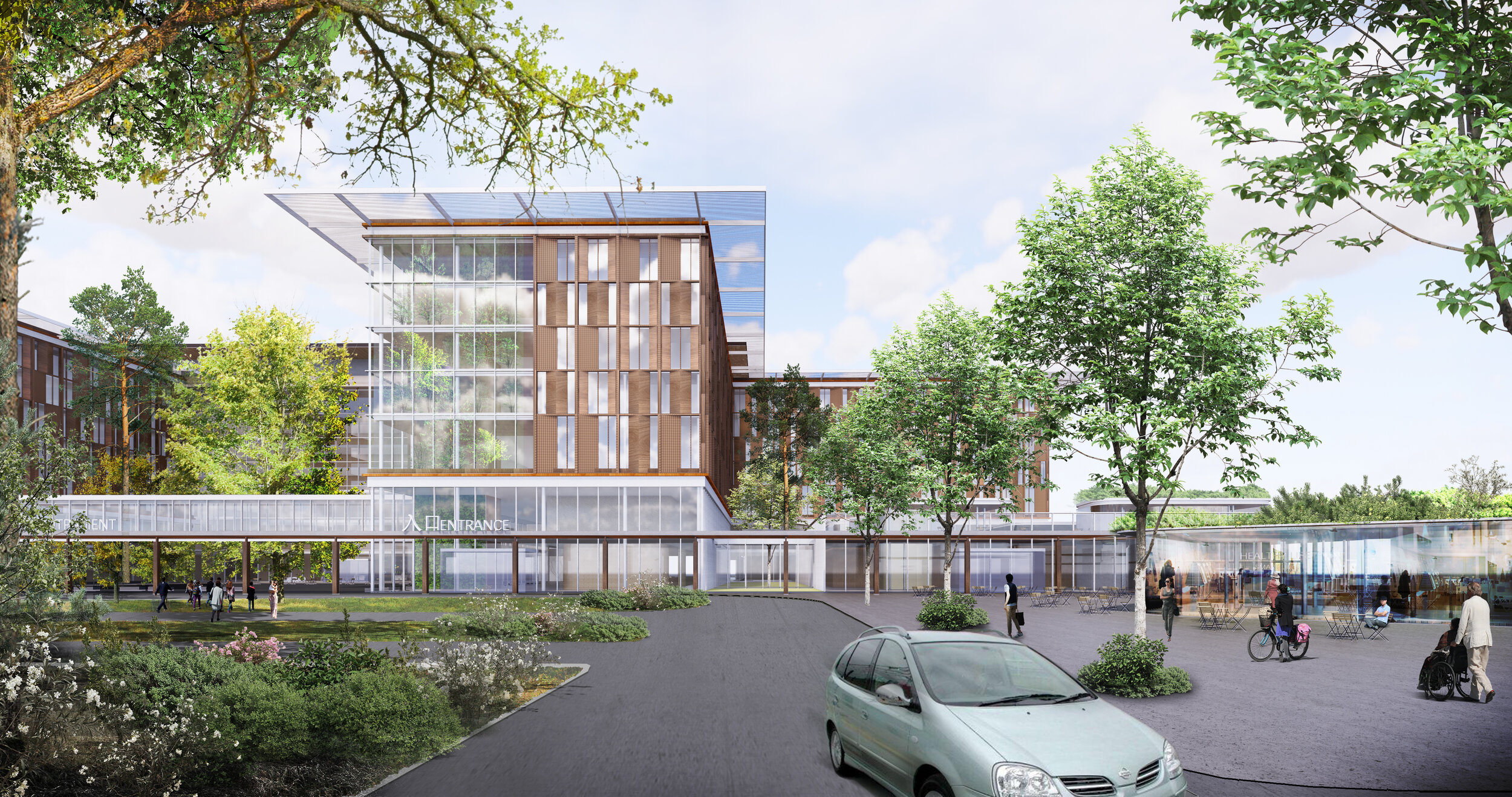
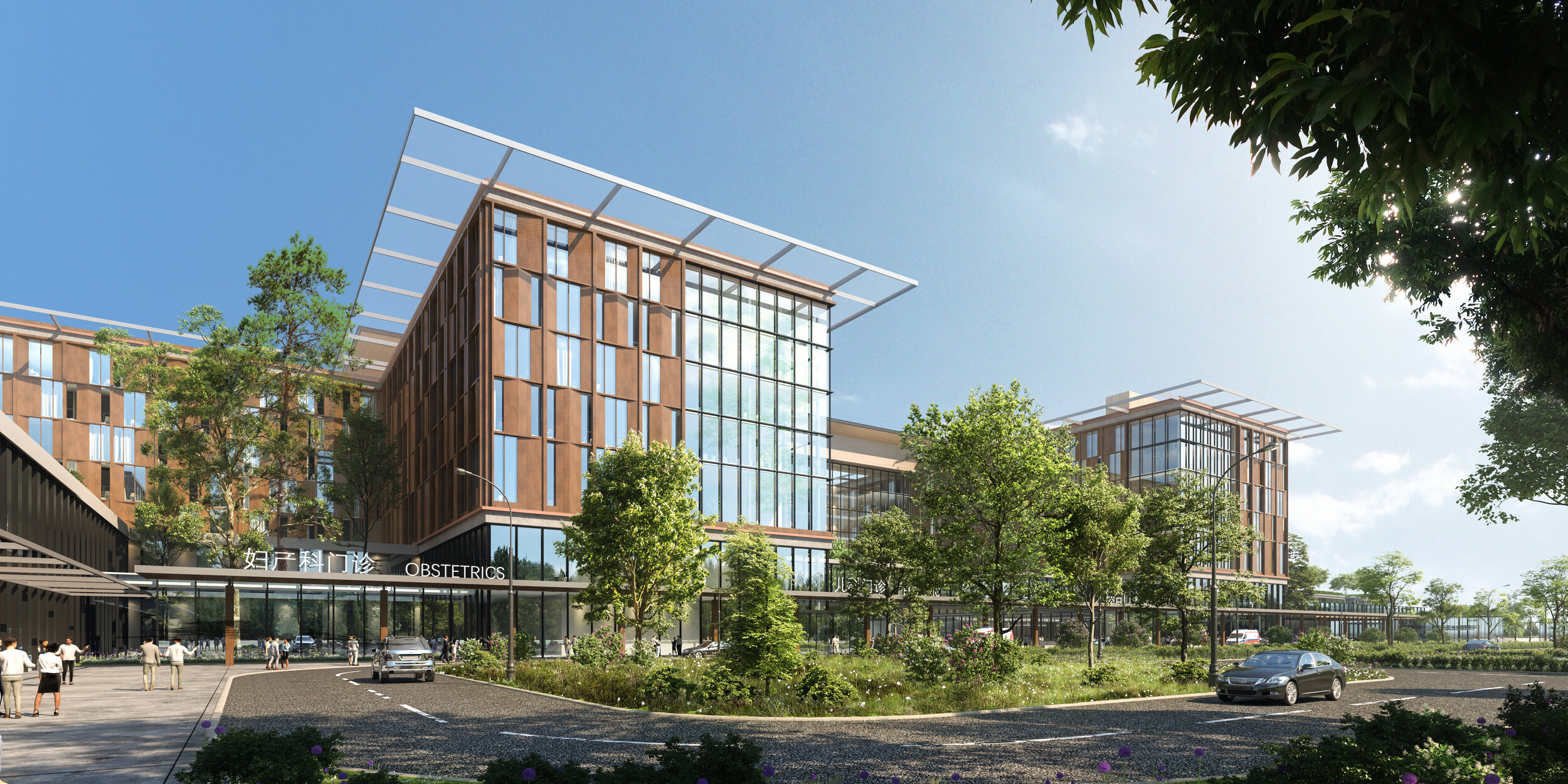
When we think of a hospital, we often simply think of a building, a series of rooms for patients and medical professionals. It should instead be seen as a place of healing at the intersection of community, innovation and nature.
We would like to expand this notion of the hospital into a place for communal healing, a place that fosters community building, a place that forges a mutually beneficial relationship with the surrounding landscape and teaches us to live healthier lives.
This be a place at the forefront of technological and healthcare innovation, it will also be a place that welcomes daily, seasonal and long term change through flexible plazas and generous public spaces.
Nature: Healing with the Land
The existing landscape has a stunning presence, luminous clouds, peaceful ponds, lush hedges surrounding familiar fields that wave in the wind. Nearby forested mountains ground the site in its larger context.
A connection to the landscape and its seasonal changes can play an instrumental role in the process of healing, if not physically, it can provide emotional and mental repose. Different buildings can interact with different landscapes, helping define their identity and the experience of their inhabitants.
A biophilic relationship between the buildings and their context also entails that the buildings should work to support the surrounding ecosystems.


Existing site conditions

Entry and Visitor Centre
Main Drop-off Access
Pediatrics and Obstetrics Drop-off

Community Corner

Ward Common Space

Emergencies Drop-off

Wellness Garden

Roof Plan

Vilnius Concert Hall

| Location: | Vilnius, Lithuania |
|---|---|
| Status: | Competition Entry |
| Date: | 2019 |
| With: | Studio Vaaro |
The New National Concert Hall “Tautos Namai” has been a long time in the making and has the potential to become a major cultural attractor and incubator for the city of Vilnius. With this goal in mind, it is critical that the House of the Nation and the two state-of-the-art Concert Halls should coexist in a way that redefines the highly symbolic site of Tauras Hill as an open, inclusive and multipurpose resource for the city. Our proposal for the National Concert Hall, a highly visible icon composed of three pure shapes, will act as a new form of social infrastructure to foster creativity, learning, and engagement with Lithuania’s strong cultural heritage.
Three Distinct Volumes
The brief calls for three main programs: the Grand Hall, the Small Hall, and the House of the Nation. Each of these programs has its own scale and specific requirements; we have chosen to express each of them as such. These three distinct, visually independent volumes carefully placed at the top of Tauras Hill allow for a clear and direct reading of the New National Concert Hall from throughout the city. The receding scale of the three buildings, from large, to medium, to small, from the more ceremonial and monumental to the more intimate and familiar, creates a dynamic yet poised addition to the Vilnius sky line. Subtle variations to the facade modulations and roof slopes of all three volumes provides them each with a unique character while allowing them to co-exist harmoniously as a whole.
1. The Grand Hall Volume
The Grand Hall is the largest of the three programs and as such, the Grand Hall Volume is the largest of the three volumes. The Hall itself is inspired by the classic European shoebox concert halls, such as the Grosser Musikvereinssaal (Vienna) and Concertgebouw (Amsterdam). The Hall interior adopts a simple and efficient shape that is dictated by the stringent acoustic requirements. The Hall itself is set back from the North, East and West facades. It is therefore expressed as a distinct volume floating within the brick facade enclosure, ensuring that it is clearly visible from the city to the North. The Grand hall foyers are shifted and stacked along the North facade, providing commanding views of Vilnius.
2. The Small Hall Volume
This mid-sized volume includes both the Small Hall and the public Entry Hall, the principal access point of the building and a performance and events space in its own right. Lifted off the ground and set back from the North and South facades, the Small Hall appears suspended above the Entry Hall, and again is clearly visible from the city to the North. Lifting the hall creates a triple-height space at the North of the Entry hall, and generous views onto the city. The Small Hall is a well-proportioned, multi-functional performance space designed for optimal acoustics and high reconfigurability. Capable of accommodating intimate piano recitals, chamber music performances, and hosting talks and gala dinners, the Small Hall is a truly flexible space.
3. The House of the Nation Volume
The smallest of the three volumes, The House of the Nation is no less powerful. The House of the Nation (HoN) itself has been conceived as a cutting-edge cultural incubator and social connector that will provide publicly accessible spaces for cultural and educational activities. Located across two levels, the HoN has deliberately been expressed independently from the two concert halls and is highly visible from the city and from the main East drop-off. The ground floor is conceived as a flexible exhibition and performance space. A double-height cutout along the North facade, with integrated bleacher seating, allows for a unique vantage point during performances and provides a visual connection to the Mediatheque and Cultural Library above. The restaurant and Library/Mediatheque programs are seen as extensions of the HoN program and as opportunities to spread awareness of Lithuanian literature, music, and cuisine. As a whole, the House of the Nation Volume will be a valuable resource that will facilitate the exchange of knowledge and ideas about Lithuanian history and culture.


Site Plan
A Place Between Grassland and Forest
Located at the top of Tauras Hill, the site lies at the intersection of two distinct landscape typologies: the mixed-forest landscape of the urban parks to the South, East and West, and the grassy slopes of Tauras hill. While these two landscapes each have their own value and iconic character, they neither form a cohesive ecological network nor welcome visitors to dwell within them.
The missing link: A Connective Central Landscape
Our site is the pinch point between these two landscapes, and the existing building on site currently acts as a barrier, disconnecting them from each other.
Through the creation of entry plaza spaces on each side of the building and a network of passageways through the site, we propose the creation of a connective landscape that reconnects the various adjacent ecosystems to the site and to one another. This not only provides pedestrian connections through the site, but also creates ecological corridors for wildlife and pollinators, as well as new hydrological opportunities for stormwater management and erosion control.
An Immersive Forest Hub
This central reconnective landscape uses planting and paving to create a gradual shift from dense forest to visually open grassland. It is a central hub of cultural activity, and a place of respite that welcomes visitors to dwell. The site is to be planted with native species of coniferous trees and fragrant ground covers that immerse visitors within a type of forest that would have once covered the majority of Lithuania, a place where one can feel both safe and in touch with the land. This planting scheme provides comfortable shelter from the noise and bustle of urban life while creating a clear and distinct landscape identity that signals one’s arrival to the concert hall.


Ground Level Plan

Native Grassland Slope

South Forest Courtyard

Grand Hall
Small Hall, during the performance of a quartet

Grand Hall Section

East West Section

Memorial to the Civilian Victims of the Korean War
| Location: | Daejeon, South Korea |
|---|---|
| Status: | Competition Proposal |
| Date: | 2020 |

Documentation Zone
The site is a valley with a creek running through it. 70 years ago, the natural flow of life in the valley was disrupted. The creek, the hills, and the trees have witnessed historical events. They were here when people were killed.
The memorial needs to accomplish two distinct aims. First, it should document and communicate historical facts. It must allow people to understand what happened. Second, it must heal and reconcile, and let people move on and continue life. It needs to restore the cultural continuity and repair the relationship to the dead.
The site is a place with many identities. A place of trauma, a place of communal grieving, a place of personal grieving, a place of healing and reconciliation and a place of learning. While these different identities are closely interconnected, they each have their own processes and must be given their own spaces to reach their full potential. Finally, the inclusion of others needs to be facilitated and procedures encouraging inclusivity are established.
Distinct zones are created through basic landscape and planting strategies. The valley is transformed through clearing the land on one end, and planting a new forest on the other. The flow of time must be stopped, so the violence is never forgotten, and it must be allowed to continue.
The Documentation Zone is the space of visible trauma and public grieving. The Memorial Hall, at the heart of the Documentation Zone, provides a secluded, intensely affective experience. The Centre for Truth and Reconciliation, is a space for communal learning and community growth, connecting different zones around it. Healing Forest, space of reconciliation and personal grieving. At the end of the Healing Forest, the Memorial Space contains columbaria and a chapel.

Site Strategy Diagrams
Masterplan

Site Aerial

Memorial Hall Plan and Section

Memorial Hall

Columbarium space and chapel details

Exhibition Building Plan and Section

Approach to Centre for Truth and Reconciliation

Crawford Co-Living

| Location: | Toronto, Canada |
|---|---|
| Status: | Completed Renovation |
| Date: | 2019 |
| With: | Wolfe ID |
Office Ou was tasked with converting a single-family dwelling into a flexible space that could either be used as co-living or divided into a number of suites. The project is part of our investigation into the densification of neighbourhoods through the re-use of traditional housing typologies. The possibilities of this flexible layout attracted new owners and the house was sold a few months following completion of the work.


Taksim Belongs to Everyone: Cultivating Spaces for Pluralism

| Location: | Istanbul, Turkey |
|---|---|
| Status: | Competition Finalist |
| Date: | 2020 |
Diversity is at the core of Instanbul's identity. Connecting Europe and Asia, Istanbul has always been one of the most internationally diverse cities; a global hub gathering people, and goods from all over the world.
Diversity is also at the core of Taksim's identity. As the modern, post-Ottoman, centre of Istanbul, Taksim is surrounded by monuments representing diverse beliefs, cultures, and ideas. Once a Greek-Armenian neighbourhood on the outskirts of the city, it was also a symbolic space of Kemalism and Modernism, a tourist destination, and a centre for Istanbul's alternative subcultures.
Methodology for Cultivating a Space for Pluralism:
Diversity is the identity of Taksim, and Istanbul. Pluralism is the explicit valuing of diversity as such. A pluralist space encourages everyone to maintain their independent cultural traditions, while at the same time including them in the overall collective.
The proposal would cultivate a pluralist space through following four aims:
Step 1
Already existing differences and identities need to be recognized, and the integrity of these identities should be preserved and enhanced.
Step 2
The Commons, a shared space where differences can be negotiated, must be clearly defined and delieneated. The Commons are a basic infrastructure for human life. They need to be accessible, and safe for everyone.
Step 3
Wherever possible, the shared commons should be enhanced in order to supported further diversity.
Step 4
Finally, the inclusion of others needs to be facilitated. Procedures encouraging inclusivity are established.

Historical Monuments of Taksim

Layers of Infrastructure for Pluralism

Masterplan - An Eclectic Scenario
Taksim Belongs to Everyone:
Taksim Gezi Park is in the southernmost green patch of the Bosphorus Green System, a system of parks that is traditionally called “koru”. The korus has situated along with Bosphorus and serves for local and immigrant fauna as well as flora.
Historic Istanbul has been surrounded by cemeteries and gardens providing fresh food for the city. Today, only a few of the gardens have been remained.
As the Gezi Park was a cemetery in past, and redeveloped as an urban park. It is still one of the most crucial green spaces within the dense urban development of Istanbul for its citizens and visitors. Its historic role of water distribution benefiting from its situation on the top of ridge-line highlights its critical role as a urban infrastructure and provision as well as opportunities to foster the ecological flows penetrating city and towards the Marmara Sea in South.

Axo of market and transport hub building

Market and Transport Hub Entrance

Taksim Square

Taksim Square at night

Pedestrian Boulevard leading to Maksem Plaza

Pedestrian Boulevard

Alphabet Sidewalk Labs Toronto Headquarters - 'Good Neighbours'
Office Ou has been selected as a finalist in an invited RFP by Sidewalk Labs, for the design of the company’s new headquarters on Toronto’s waterfront. Housed in a repurposed industrial building, this will be a workspace and testing ground for new urban design proposals and technologies for the next 3 to 5 years, until the building is demolished to make way for Sidewalk Labs’ Quayside development.


| Location: | Toronto, Ontario |
|---|---|
| Status: | Finalist RFP Entry |
| Date: | 2018 |
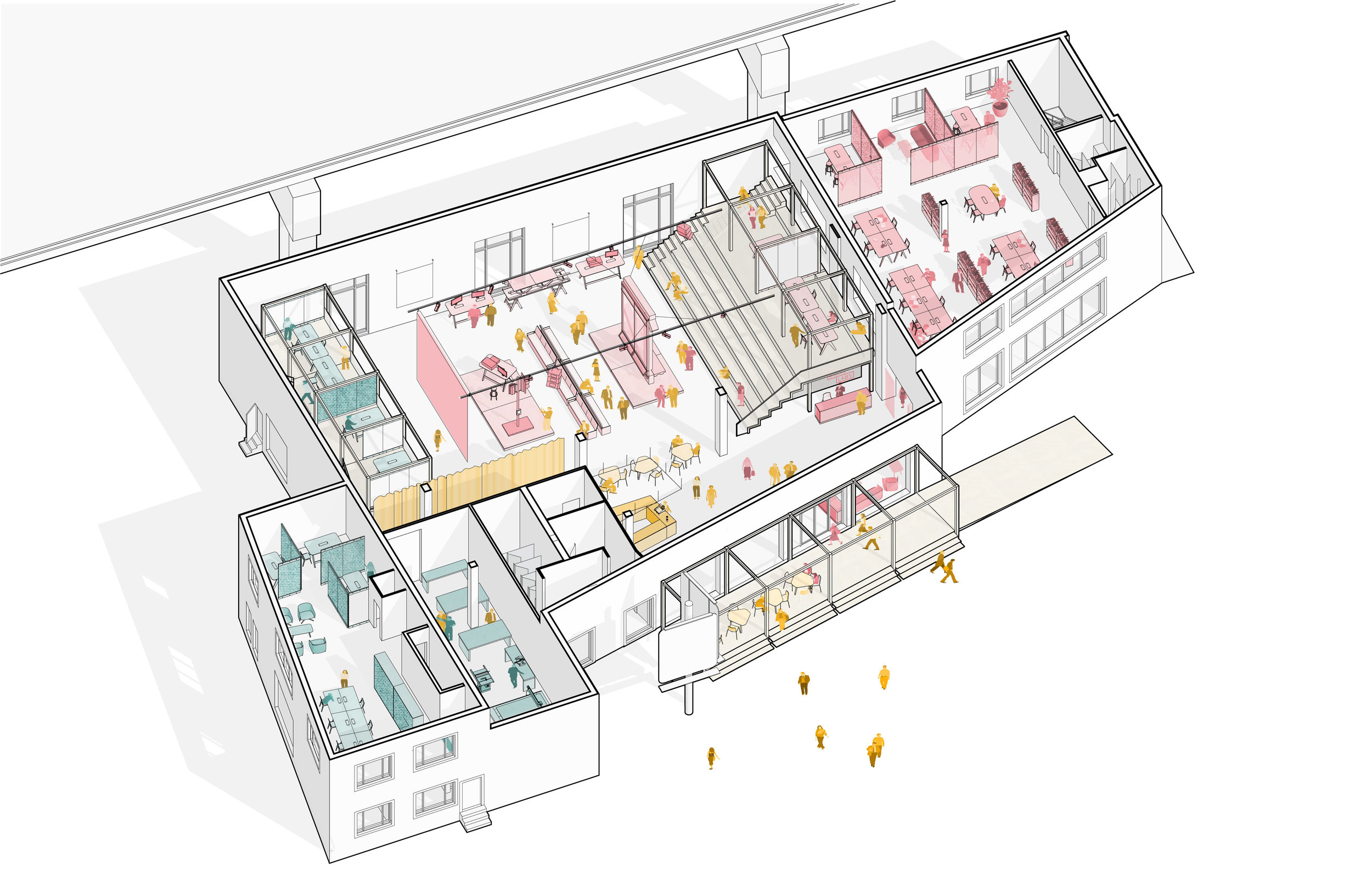
Office Ou was invited by Sidewalk Labs to propose a design for their new Toronto Headquarters, and has been selected as a finalist. Housed in a repurposed industrial building, this will be a workspace and testing ground for new urban design proposals and technologies for the next 3 to 5 years, until the building is demolished to make way for Sidewalk Labs’ Quayside development.
Quayside is a very ambitious urban design experiment which may have a widespread influence on future development in the Portlands and beyond. We believe that whether it succeeds or not will depend largely on how well Toronto's citizens are involved.
We asked ourselves, how can architecture support community building, welcome local citizens in, and provide a productive interface between Sidewalk’s ongoing research and the many groups who hold an interest in the project? The other imperative is sustainability, which is also a major theme of Sidewalk’s urban design work. How can a temporary building be made sustainable? And how to do it all on a very tight budget?


A set of 'porches' structure the interior space and provide interfaces between different areas - inside to outside, public to private
The site strategy creates an inviting and flexible space that builds up ecological value and reduces stormwater runoffs.

Office/Commons Porch, Workshop/Commons, and Front porches, in different configurations

Project cubbies, demountable walls, benches, platforms
Our proposal is structured around a set of three large wooden ‘porches’, which mediate between the building and city, and between the internal public space and Sidewalk’s offices / workshops. We were inspired directly by the porches of ordinary houses across the city, which offer a place for neighbors to get to know each other and, house by house, form a community. The porches act as as set of stages and thresholds to structure interactions within and in front of the building.
Given the highly diverse and uncertain uses that may occupy Sidewalk Labs HQ, the rest of the project is implemented as a furniture-scaled, mobile kit of parts. These components, including project cubbies, platforms, benches, and demountable walls, are designed to be rapidly fabricated out of plywood using Sidewalk’s own CNC equipment, and set up in a range of scenarios. This allows the space to change and grow while retaining a cohesive identity. Some uses will be directly related to Sidewalk’s work, and some are purely for the local community’s use. We expect to Sidewalk HQ could restore some of the spaces that are disappearing within the city: concert and performance venues, affordable work / creative space, outdoor event space and even public gardening space.
Sharing space will ensure continued visibility for Sidewalk Labs’ project for Quayside, and encourage collaboration with community groups, universities / colleges, artists and writers, residents, and everyone who has something to contribute.
The temporary nature of the project also suggested a different approach to sustainability, less focused on energy use, and more on what becomes of the project beyond its first lifespan. All the porches and mobile components are designed with upcycling, flexibility, and biodegradability in mind from the very start. The new elements in our proposal can be subdivided and repurposed into parklets and pollinator gardens to be distributed throughout the city through partnerships with local organizations and community groups. Other materials (like mycelium board) can biodegraded into growing medium. This intentions are made very clear by labeling every space or element in the building with its future identity. This built-in capacity for transformation ensures that the time and money invested now, will have an impact well beyond the project’s expected lifespan.

Hackathon
Product / system demonstration

Lecture

Performance


Labeling System

Porch Reuse

Curtain Reuse


Lety u Písku

| Location: | Lety, Czech Republic |
|---|---|
| Status: | Finalist Design |
| Date: | 2020 |
Running through the length of the site, the scar is the physical manifestation of a story which has been buried, the story of the Roma and Sinti. Constant, unwavering and unbroken, it is meant to relay that the land and its people have witnessed a trauma.
While the site’s final design cannot fully be defined without the input of survivors, their families and the Roma and Sinti communities, the proposal creates a procession through the site: from the visitor center, the scar leads visitors from the waters of Lipes Pond, north through the pig farm, a contemporary layer of trauma, and into the reconstructed concrete walls of the so-called- Gypsy camp, from which visitors emerge into the forest to gradually meet the burial site. This procession is meant to be an immersive, solemn and informative experience, where visitors begin to understand the complex layers of the site’s history. It is an experience where layers of history intersect with current conditions to illustrate the story of Roma and Sinti people in Bohemia.
We believe this memorial can also become a gateway to the story of Roma and Sinti in the broader region, and educational trails and pathways will reconnect critical historical sites to the memorial: the quarry, the parish cemetery in Mirovice and the train station. This will be done through trail markers and a series of new benches and informational signage that use the same materiality as that of the memorial.

Site Plan
Following the scar, the story of the site unfolds and the history of the Roma and Sinti is revealed. The Scar brings visitors through a procession of stories, artifacts, empty spaces, narrow pathways, successional forest-scapes, and memorials. Whether arriving on site via the parking lot on the west, or through the trails connected to Lety and neighbouring towns, the memorial’s elements form a sequence that can be viewed in many different orders. The story of the site can begin at the visitor centre where introductory material is provided and the basic necessities of the site are located. The visitor centre is a point of departure, or point of comfort, and a hub for all exhibition buildings on site.
Repurposed pig farms house exhibition and museum spaces that showcase the history of the Roma and Sinti before, during and after WW2, as well as introducing spaces for more contemporary cultural exhibits. The pig farms stand as a fragment of the site’s history, namely an attempt to cover up and disregard the atrocities which took place on the land. To demolish the farm would effectively erase an important aspect of the site and the narrative: that for so long after the war, the story of this land has been ignored and hidden. Overall, these spaces provide 2059 m2 of open air performance and exhibition spaces and 2000m2 of temperature controlled closed exhibition space. These newly repurposed spaces should also be a platform for contemporary Roma and Sinti culture, supporting their agency. They should be safe spaces, spaces of resilience where Roma and Sinti culture can thrive through cultural and artistic expression, installations, performances and lectures. During the first phase of construction we foresee repurposing one farm building to contain all exhibits; these exhibits could during the second phase be split into two buildings and expanded with contemporary cultural content.
As one moves along the scar, the pig farms deconstruct and give way to the resurrected camp walls. The scar, a 0.4m deep physical cut in the landscape, deepens to 2.5m by the camp walls, allowing visitors to pass through this barrier that was a prison for so many. The ground slopes towards the scar to create entry points and guards as needed. The scar releases visitors into the barren camp, where only emptiness greets them. Ruins of camp buildings are intended to be maintained within the camp walls, however this site is intended to be a contemplative void. The scar is built out of concrete, with a thin slice of weathering steel embedded at the top, changing the concrete’s patina over time.
Passing through the only narrow cut in the camp walls, one is directed towards the burial ground. This pathway through the forest is a direct juxtaposition with the emptiness within the camp boundary. It is meant to be a reflective moment for visitors intended to quietly lead them to the burial site. Along that path, a series of wayfinding and minimal concrete benches would tell the story of the different victims, building a personal portrait that culminates in the arrival to the burial ground. Whether it is the beginning of the procession, or the end, Lipes pond lies at a point of intersection with the scar. The physical manifestation of pain vanishes into the shores of the pond’s waters.


Approaching the Former Camp
The building strategy aims to be sensitive to the memory of the site as well as lower carbon footprint by reusing existing structures and reducing new construction on site. Rather than removing the entirety of the pig farms on site, erasing their memory as an integral part of the traumatic history of the site, we propose reusing a selected few pig farms as exhibition and performance spaces. With minimal gravel and soil infilling, as well as interior retrofits and insulation, the buildings can help tell the story of the site, while minimizing new construction and waste. The pig farms are deconstructed into four primary forms.
The only new structure we foresee being erected on site would be the visitor center. While occupying a small footprint, the visitor center would be a hub for knowledge on the site and the regional network of historically significant places. It contains an information center, office spaces with necessary amenities, storage and warehouse spaces and public restrooms. The design is minimal yet functional, and offers flexibility to expand any spaces required. Its canopy creates sheltered seating and gathering spaces for groups, as well as a contemplation garden, which we imagine being home to a Roma or Sinti art installation, facing the entry to the scar. This building can be built to passive house and electricity net-zero standards. Use of high-efficiency air-sourced heat pumps and hydronic radiant heating would be offset by the use of low-profile solar panels located within the flat roof of the building.

Pig Farm deconstruction

Exhibition space

Entry and Visitor Centre

A Home for Art Within Nature: Dugok-ri Cultural Resource Facility

| Location: | Dugok-ri, South Korea |
|---|---|
| Status: | Competition Proposal |
| Date: | 2020 |
The landscape of this part of Hoengseong-gun is defined by a mix of lush forested hills and productive agricultural fields. This mix of ancestral nature and productive landscapes provides a rich context for a new cultural facility. This facility aims to become a revitalizing cultural and economic force for the region, but also provide a platform for local creativity, and work as a hub for a new regional network of cultural institutions (some existing and some new).
The Cultural Resource Centre Complex is to be built in a secluded rural location, which offers it bold opportunities for connecting with the rich local landscape of forested hills and fields. A home for art must be designed within the local landscapes, taking cues from the site to define its placement. It rises upward from the valley of agricultural fields, yet comfortably nestles within the lush forested hills, respecting the local typology and flows of the site. It must proudly represent the beauty of local lifestyles (through spatial organization, materiality and building programming) while humbly embedding itself within the land.
Context Plan

Building Site Plan
The site plan makes full use of the local topography to provides efficient access for visitors, staff and loading while respecting the local landscape and providing a unique way to experience art within nature (both fields and forests).
The building stacks and flows along the site’s topography, making use of the different datums to create separate access points: Public access happens uphill while private access (loading and staff) happens downhill. The main public entrance is located within a peaceful central forecourt enclosed by the hills and the building, it is accessible from all sides, whether visitors are coming from local villages, mountain paths or by local transit or car. The central public area beyond that forecourt extends onto the roofs of the private spaces below, these public terraces become flexible exhibition areas with magnificent views of the surroundings.

Building Morphology

Elevation and Section


Pedestrian Boulevard

View towards main entrance forecourt

Spirit of Forgotten Forests
京都の町において、人々の生活や信仰の場として自然は常に身近で神聖なものであり、町を包み込む温かい布のようなものとして大切に扱われてきた。そしてすべての自然は平等に貴重であり、自然の要素である木や石、水、土すべてにそれぞれのSpiritが宿っているという人々の自然に対する愛がこの町を自然と美しく共生する日本の文化の中心地として形作ってきたであろう。

| Location: | Kyoto, Japan |
|---|---|
| Status: | Competition Entry |
| Date: | 2018 |
Plan and Section
A project in collaboration with Asuka Kohno
Kyoto was built on the strength of a very intimate relationship between the human realm and the nature which cradles it. From that relationship, an appreciation of landscapes and their changing character grew to become an integral part of the rituals of daily life (a folklore of spirits, hidden in light and obscurity, in the movement or stillness of plants and water, of soils and stones.)
Long ago, the site of this project was a forest, but today it is nothing more than an isolated patch of greenery, disconnected from its traditional presence in daily life by tall hedges; but take a peek behind the hedges and you’ll find a forest with its own story to tell.
Besides the formal pathways, sidewalks and parking lots that have become the spaces of daily life, we find a small patch of forest yearning to be rediscovered. We enter and find three distinct landscapes, each with its own character, its own spirit. To communicate with these landscapes we insert a small temporary structure inspired by that landscape, a lantern-like device to capture and amplify its unique qualities. These structures invite us to dwell within a forgotten forest, to observe its beauty, and immerse ourselves in its stories with all of our senses. In addition to existing hedges, we designed simple earth walls, benches and plantings that guide people's gaze and movement towards discovering the three different spirits of the site. The sequence through the site is designed to engage visitors in a playful game of hide-and-seek with each of the three landscapes.

Procession / Experiences
Three spirits of the site:
A. 温糺室 / A warm room
Under a dense coniferous forest canopy, warm waterways course through herbaceous plants; within this soft and humid space, one feels cocooned within the warmth of the local ancestral forests that once occupied the site.
B. 木漏れ日 / Sunlight and shadows
Further into the site, the shadows of barren deciduous trees sway in the wind. Within the shoji-like enclosure, visitors find a place where they can enjoy the theatrical performance created by the winter forest.
C. 巣床 / Burrow / Nest bed
Furthest along the path, animals look for places to nest and burrow. Visitors are invited to lower their point of view, hiding themselves close to the ground in a sheltered place where one can see without being seen, and experience a rarely seen side of the forest.

Construction system and timeline

Winnipeg Warming Huts
To bring warmth to a Winnipeg winter, we propose a simple and evocative set of curving walls made of undyed industial felt.

| Location: | Winnipeg, Manitoba |
|---|---|
| Status: | Competition Entry |
| Date: | 2018 |
To bring warmth to a Winnipeg winter, we propose a simple and evocative set of curving walls made of undyed industial felt. Felt is an ancient material that speaks to us of warmth and comfort not only through it’s insulating qualities, but also it’s soft texture and colour, its density and round sculpural forms. Rather than creating a single enclosed space, the meandering walls form pockets of shelter, sized for groups from 3 to 10. At 3.0m high, the walls are high enough to create a sense of deep enclosure, but still open to views of the Forks. The felt will be made rigid and self-supporting by being soaked in water and frozen in the -30°C cold. The assembly process will be a performance in itself, as a pump draws water up from below the river’s frozen surface, and transforms a flimsy substance, hung from portable frames, into a hard shell that nonetheless appears soft.

Construction Process


No. 9 Gardens
No. 9 is a Toronto-based arts organization with a mission to educate youths about environmental concerns through art and design. Following several years of delivering educational workshops with school boards and arts institutions, No. 9 is now taking the leap to develop its own educational camp, that will not only teach, but also test and develop the latest practices in sustainable building and agriculture.

| Location: | Lyndhurst, Ontario, Canada |
|---|---|
| Status: | Masterplanning |
| Date: | 2018 |
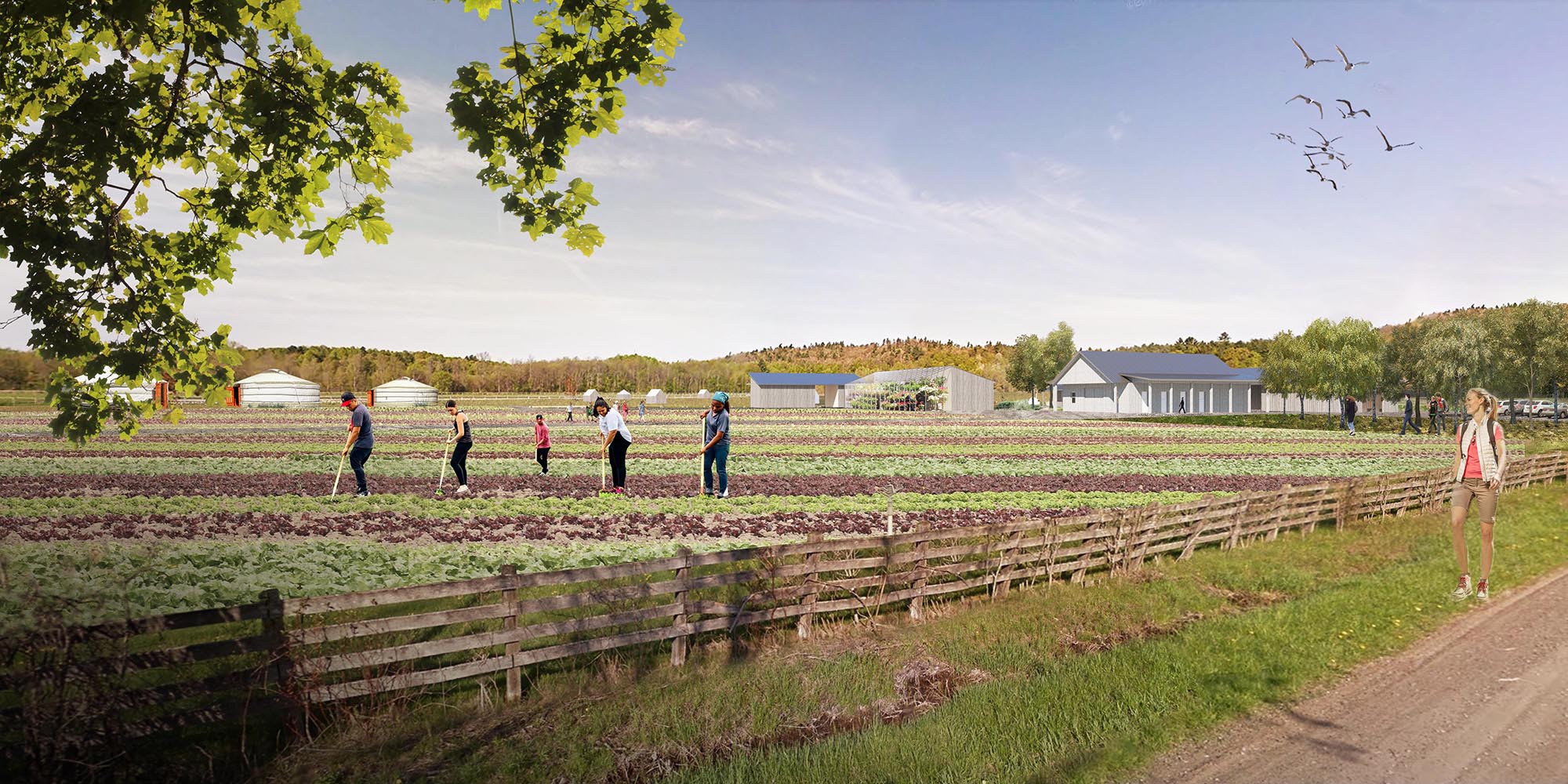
No 9 is a Toronto-based arts organization with a mission to educate youths about environmental concerns through art and design. Following several years of delivering educational workshops with school boards and arts institutions, No 9 is now taking the leap to develop its own educational camp, that will not only teach, but also test and develop the latest practices in sustainable building and agriculture. In collaboration with Sandra Iskandar Architect (responsible for building design and general layout), Office Ou is developing a masterplan for the No. 9 Gardens, defining a comprehensive set of sustainable building and landscape strategies.
The project includes an existing barn plus a greenhouse, classrooms, culinary kitchen, dormitory, and a wood/metal fabrication studio, all organized around a central wildflower garden / gathering space. The surrounding landscape is a designed to fit the existing site conditions



TRK Winery
The client is interested in creating a winery that provides visitors a unique experience, a way to feel engaged in the wine-making process. This winery will not cater to large tour groups, but instead welcome smaller groups of visitors that would like to learn and even take part in the life of a vineyard.
The winery will also include a small inn to provide accommodation to visitors to allow them to dwell on site longer and properly experience the daily processes of the winery.
Location: Niagara-on-the-Lake, Canada
Status: Planning
Date: 2018
The client is interested in creating a winery that provides visitors a unique experience, a way to feel engaged in the wine-making process. This winery will not cater to large tour groups, but instead welcome smaller groups of visitors that would like to learn and even take part in the life of a vineyard.
This winery will include a range of different spaces, from productive areas (fermentation room, barrel room, bottle storage room, lab, etc...), educational spaces (conference rooms, seminar rooms, tasting room), and commercial spaces including a small bistro and store. It will also include a small inn to provide accommodation to visitors to allow them to dwell on site longer and properly experience the daily processes of the winery.


In order to do that, we’ve designed a building that engages the surrounding productive landscapes, directly linking the vineyards to the internal processing spaces of the building. As visitors explore the winery they are able to gain an under- standing of the wine-making process and of the landscapes that support it (the grapevines, the supporting pollinator species and indicator species).
The project will be split into three different phases. Phase 1 will include construction of the main production space and a small commercial area. Phase 2 will add the educational facilities, and extend the production area. Phase 3 will add the inn component of the project and a distillery.
The first phase of the project is due to be completed in 2018.

Creemore House
The clients acquired a 5 ha piece of land near Creemore with a dream of living on a site where they can grow their own food as well as processing it into different types of preserves, dry goods and cooked dishes. We designed their home as a flexible productive hub, a place whose identity changes with the seasons, and the agricultural and culinary activities associated with different times of the year.

| Location: | Creemore, Ontario |
|---|---|
| Status: | Construction |
| Date: | 2018 |
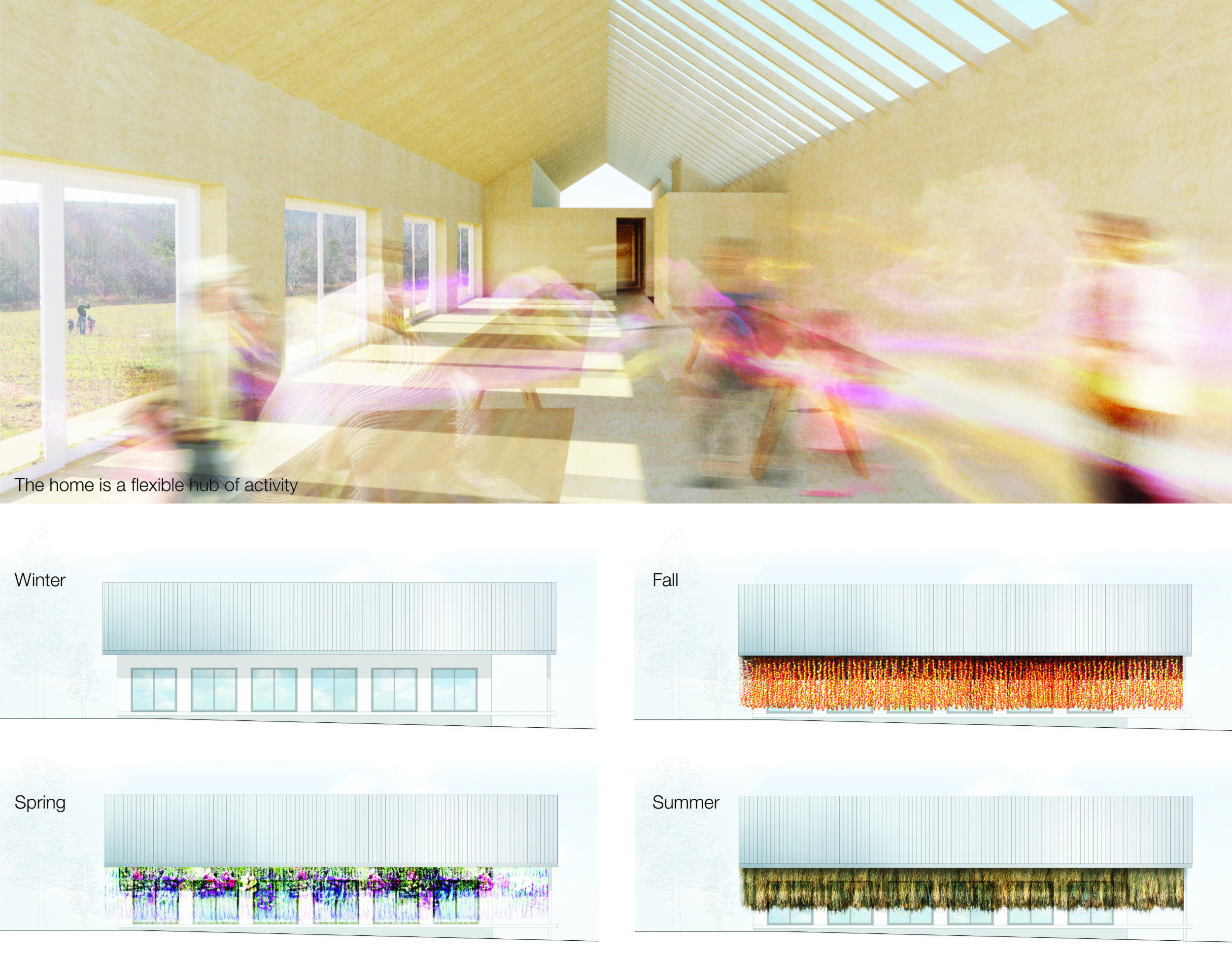
The clients acquired a 5 ha piece of land near Creemore with a dream of living on a site where they can grow their own food as well as processing it into different types of preserves, dry goods and cooked dishes. We designed their home as a flexible productive hub, a place whose identity changes with the seasons, and the agricultural and culinary activities associated with different times of the year.
The house has a large flexible interior, an east-facing patio for processing crops, and large overhangs on the South side equipped with a hanging system to dry all kinds of site-harvested foods including persimmons, wild flowers, radishes, cattails, wild rice, etc... Most drying activities take place during spring, summer and fall, taking optimal advantage of the southward exposure of the house.
During the winter, when the sun is lower in the sky, the facade is not used for drying any produce, letting the sun shine far into the house, passively warming it.
This house is another foray into the use of straw as insulative material, and the building envelope reaches R-values of 45-50 through the use of 16” thick walls made of locally harvested straw.

Biophilic Housing Matrix
Many of climate change’s threats — floods, droughts, loss of biodiversity and food systems — disproportionately affect cities as urban populations rise. How a city like Seoul is designed in relation to social and natural systems has tremendous consequences for urban resilience, the capacity to feed populations, and the ability to prevent, survive, mitigate, and adapt to climactic and environmental change. The biophilic housing matrix tackles issues of urban resilience by intertwining productive natural systems and housing.
| Location: | Seoul, South Korea |
|---|---|
| Status: | Research / Publication |
| Date: | 2017 |
Many of climate change’s threats — floods, droughts, loss of biodiversity and food systems — disproportionately affect cities as urban populations rise. How a city like Seoul is designed in relation to social and natural systems has tremendous consequences for urban resilience, the capacity to feed populations, and the ability to prevent, survive, mitigate, and adapt to climactic and environmental change. The biophilic housing matrix tackles issues of urban resilience by intertwining productive natural systems and housing.


Our definition of urban resilience draws on theories from ecology, disaster risk reduction, urban planning and governance – but is based primarily on the Panarchy theory of resilience by system ecologists Gunderson and Holling. Resilience, or the tolerance of a system, is defined by the capacity it has to absorb disturbance and reorganize while retaining the same function, structure, identity, and feedbacks. Applied to the context of Seoul, our proposed interventions explore how the following resilience-bolstering design principles manifest in the built form: Social and ecological integration, small scale action with large scale thinking, always be learning and modularity.
These 4 design principles are applied to our concept, as we aim to connect people to one another and to an urban ecology through agricultural production. We are interested in exploring opportunities for ecological and agricultural cultivation and harvesting as an integrated live/work experience. The resulting productive networks create communities and identities defined by purpose, place, and production. Among the many types of typologies that can be created, this project elaborates upon orchard homes, pollinator meadow homes and urban farm homes for food production.


Condominium Renovation
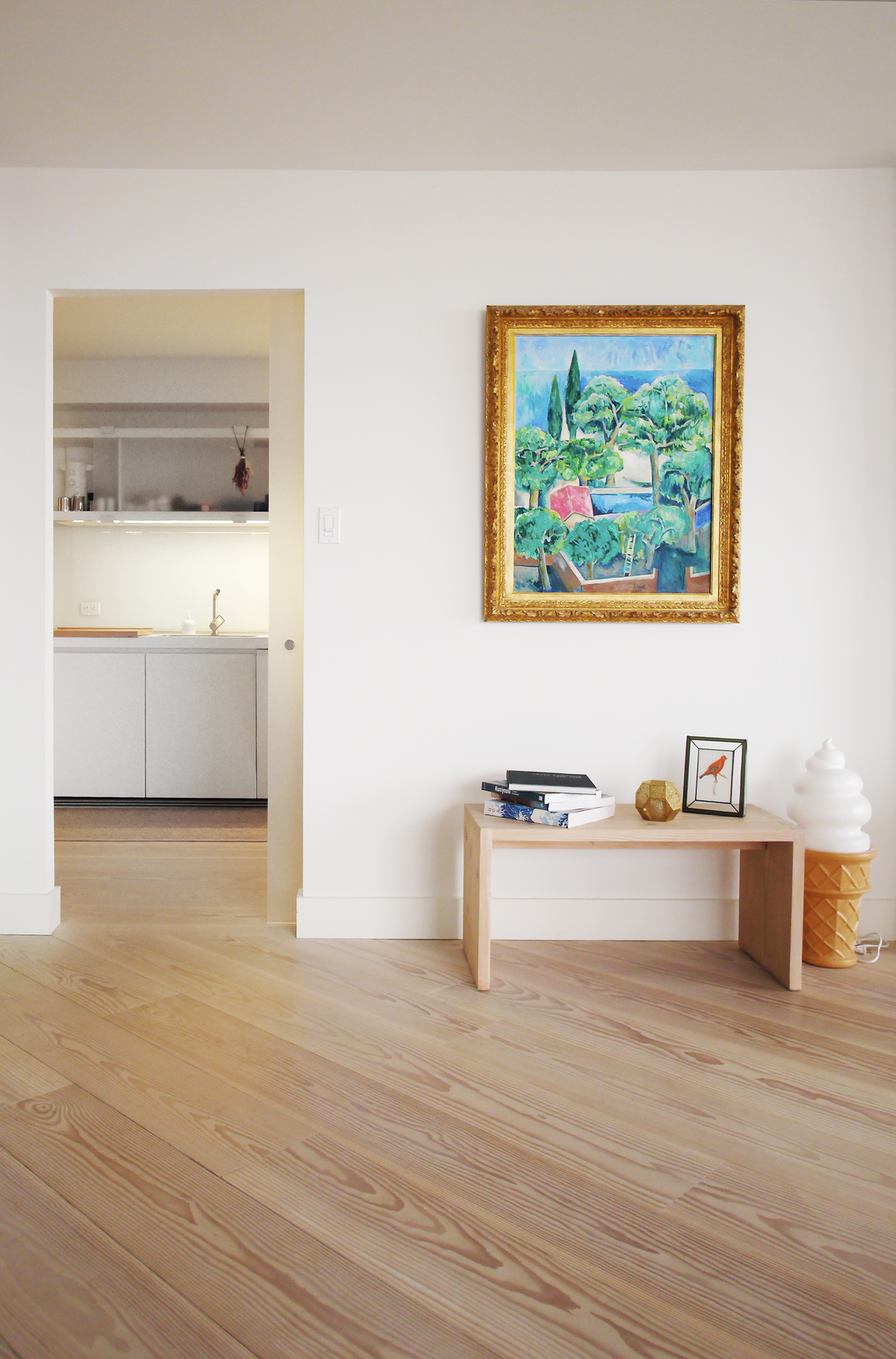
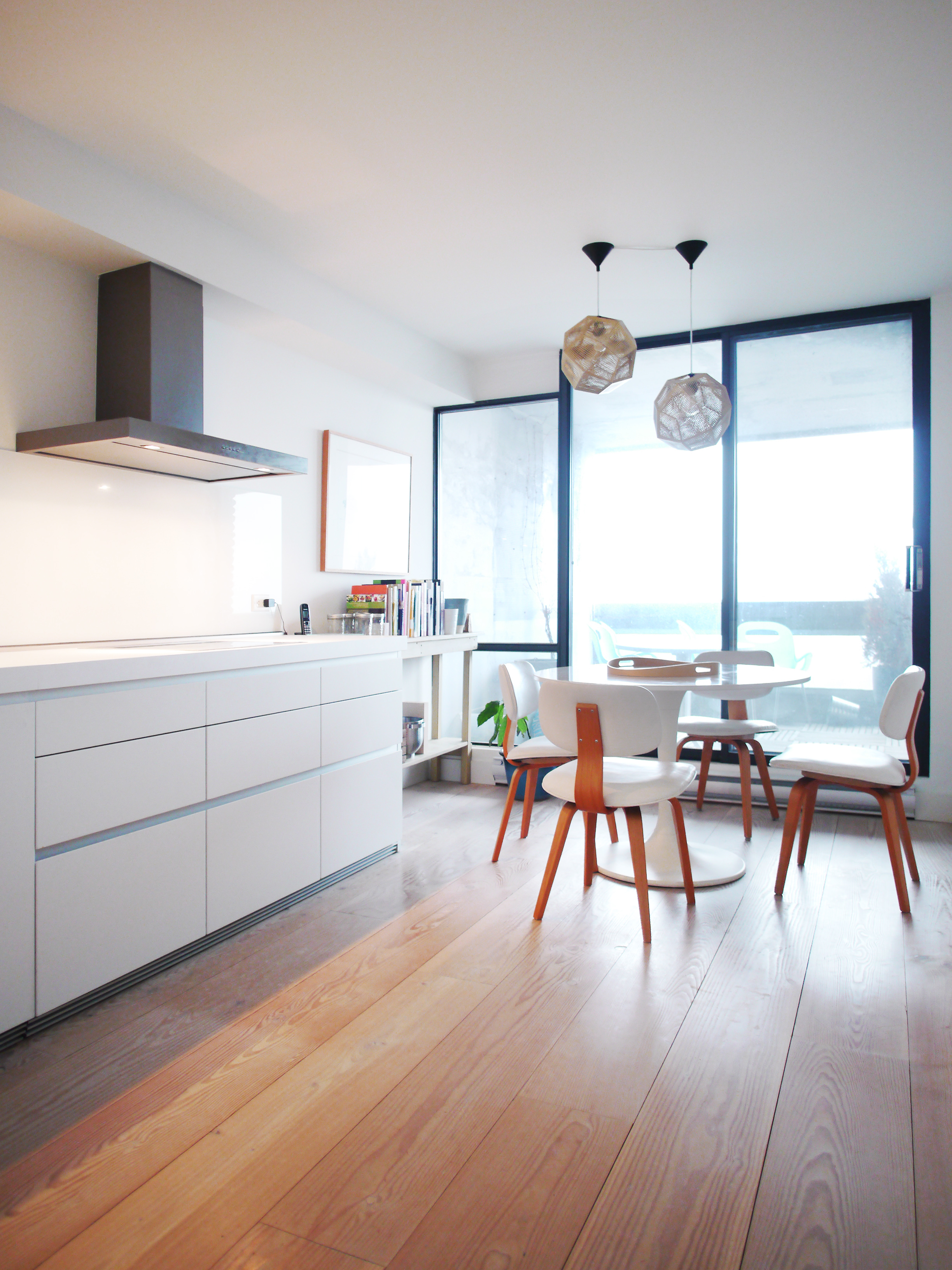
The condominium was outdated and flood- damaged. Years of neglect had left its walls and carpeting cigarette-stained. Yet we knew this place could once again become a comfortable homestead through the use of natural materials like untreated douglas fir, which was used as flooring material and for the construction of benches as well as headboards.
This full condominium renovation transformed a neglected interior into a simple and contemporary canvas for the owners to exhibit their art and antiquities collections.
| Location: | Toronto, Ontario |
|---|---|
| Status: | Built |
| Date: | 2013 |
The condominium was outdated and flood- damaged. Years of neglect had left its walls and carpeting cigarette-stained. Yet we knew this place could once again become a comfortable homestead through the use of natural materials like untreated douglas fir, which was used as flooring material and for the construction of benches as well as headboards.
This full condominium renovation transformed a neglected interior into a simple and contemporary canvas for the owners to exhibit their art and antiquities collections.