

416 Park and Memorial
Beyond the water, a forest of tall trees stands out even from a distance. Below these trees, twinkling lights, and a solemn space to gather and commemorate the tragedy of the Sewol Ferry. This is the first scenery that people who visit 416 park will encounter.

| Location: | Asan, South Korea |
|---|---|
| Status: | Competition Entry |
| Date: | 2021 | With: | HLD Landscape |
Beyond the water, a forest of tall trees stands out even from a distance. Below these trees, twinkling lights, and a solemn space to gather and commemorate the tragedy of the Sewol Ferry. This is the first scenery that people who visit 416 park will encounter.
The Sewol ferry disaster touched all of Korean society. 416 park will welcome people so that they may commemorate the victims of the tragedy, and find hope and support in the midst of sorrow. There are still many questions that remain unanswered about the ferry disaster, and 416 park must also be a place to gain understanding and find answers to these questions. 416 park is a place with many different identities: a place of mourning and commemoration, a place of learning and solidarity, and a place to cherish life and live each day with hope in our hearts.
The twinkling lights in the forest lead to a space with stone slabs that symbolize all the anonymous citizens who participate in the remembrance process. This is a collective memory space that invites all to reflect upon the events of 4/16. Glass blocks placed between the stones transmit warm sunlight to the space where the 250 of the victims from Danwon High School are laid to rest. Light shines down into the underground, illuminating a place for more inward remembrance, away from the crowds, and when the evening twilight sets, 304 points of light shine into the night.

The stone slabs of the collective memory space


Light shines from above, into the space of remembrance
Spaces of solidarity and spaces of remembrance
The park has many roles to play: it must support mourning, commemoration, learning, healing, and finally the day-to-day life of the local community. These roles must coexist without conflict. Certain roles require dedicated spaces, a singular place of remembrance and enshrinement, a place with amenities for community building and support, etc… These spaces have distinct identities, but are connected through a pathway that also provides access to the the exhibition and documentation spaces.


All facilities on site function independently while being connected. Mostly underground, the community and exhibition spaces have a subdued expression.
A subdued yet inviting community center and office pavillion, is located to the south, above the storehouse for ease of loading and access. Connected to this building, but publicly accessible from the central ramp, the exhibition space and large multi-purpose hall provide a different experience. These are also conveniently located adjacent to the storehouse.
The Exhibition Spaces
The exhibition lobby is accessed from the ramp that leads to the commemoration spaces. Upon entering, visitors can access the multi-purpose hall at the same level, or proceed to the exhibition spaces located underground (at the same level as the storehouse). Permanent and special exhibition spaces are located across from each other around a central courtyard, allowing each to have its own procession.
Nature and life permeate almost all spaces on site, whether it be through light, forests or water. The exhibition building follows that thread by having at its core a vegetated courtyard, around which major circulation is structured. It is a way to bring light down and anchor an element of life into a place that not only educates visitors about a tragedy, but also commemorates the life of the victims.
The Community Plaza
Unlike the exhibition and commemoration components of the site, the community center, along with its surrounding landscape should foster a sense of welcoming and inclusion. It is a place that provides ongoing support to the local community and should feel warm and comfortable rather than iconic and monumental. The community center prioritizes horizontality, maximizing connections to the plazas and forest that surround it. It disappears from view as visitors descend along the path that leads to the exhibition and commemoration spaces.

Vilnius Concert Hall

| Location: | Vilnius, Lithuania |
|---|---|
| Status: | Competition Entry |
| Date: | 2019 |
| With: | Studio Vaaro |
The New National Concert Hall “Tautos Namai” has been a long time in the making and has the potential to become a major cultural attractor and incubator for the city of Vilnius. With this goal in mind, it is critical that the House of the Nation and the two state-of-the-art Concert Halls should coexist in a way that redefines the highly symbolic site of Tauras Hill as an open, inclusive and multipurpose resource for the city. Our proposal for the National Concert Hall, a highly visible icon composed of three pure shapes, will act as a new form of social infrastructure to foster creativity, learning, and engagement with Lithuania’s strong cultural heritage.
Three Distinct Volumes
The brief calls for three main programs: the Grand Hall, the Small Hall, and the House of the Nation. Each of these programs has its own scale and specific requirements; we have chosen to express each of them as such. These three distinct, visually independent volumes carefully placed at the top of Tauras Hill allow for a clear and direct reading of the New National Concert Hall from throughout the city. The receding scale of the three buildings, from large, to medium, to small, from the more ceremonial and monumental to the more intimate and familiar, creates a dynamic yet poised addition to the Vilnius sky line. Subtle variations to the facade modulations and roof slopes of all three volumes provides them each with a unique character while allowing them to co-exist harmoniously as a whole.
1. The Grand Hall Volume
The Grand Hall is the largest of the three programs and as such, the Grand Hall Volume is the largest of the three volumes. The Hall itself is inspired by the classic European shoebox concert halls, such as the Grosser Musikvereinssaal (Vienna) and Concertgebouw (Amsterdam). The Hall interior adopts a simple and efficient shape that is dictated by the stringent acoustic requirements. The Hall itself is set back from the North, East and West facades. It is therefore expressed as a distinct volume floating within the brick facade enclosure, ensuring that it is clearly visible from the city to the North. The Grand hall foyers are shifted and stacked along the North facade, providing commanding views of Vilnius.
2. The Small Hall Volume
This mid-sized volume includes both the Small Hall and the public Entry Hall, the principal access point of the building and a performance and events space in its own right. Lifted off the ground and set back from the North and South facades, the Small Hall appears suspended above the Entry Hall, and again is clearly visible from the city to the North. Lifting the hall creates a triple-height space at the North of the Entry hall, and generous views onto the city. The Small Hall is a well-proportioned, multi-functional performance space designed for optimal acoustics and high reconfigurability. Capable of accommodating intimate piano recitals, chamber music performances, and hosting talks and gala dinners, the Small Hall is a truly flexible space.
3. The House of the Nation Volume
The smallest of the three volumes, The House of the Nation is no less powerful. The House of the Nation (HoN) itself has been conceived as a cutting-edge cultural incubator and social connector that will provide publicly accessible spaces for cultural and educational activities. Located across two levels, the HoN has deliberately been expressed independently from the two concert halls and is highly visible from the city and from the main East drop-off. The ground floor is conceived as a flexible exhibition and performance space. A double-height cutout along the North facade, with integrated bleacher seating, allows for a unique vantage point during performances and provides a visual connection to the Mediatheque and Cultural Library above. The restaurant and Library/Mediatheque programs are seen as extensions of the HoN program and as opportunities to spread awareness of Lithuanian literature, music, and cuisine. As a whole, the House of the Nation Volume will be a valuable resource that will facilitate the exchange of knowledge and ideas about Lithuanian history and culture.


Site Plan
A Place Between Grassland and Forest
Located at the top of Tauras Hill, the site lies at the intersection of two distinct landscape typologies: the mixed-forest landscape of the urban parks to the South, East and West, and the grassy slopes of Tauras hill. While these two landscapes each have their own value and iconic character, they neither form a cohesive ecological network nor welcome visitors to dwell within them.
The missing link: A Connective Central Landscape
Our site is the pinch point between these two landscapes, and the existing building on site currently acts as a barrier, disconnecting them from each other.
Through the creation of entry plaza spaces on each side of the building and a network of passageways through the site, we propose the creation of a connective landscape that reconnects the various adjacent ecosystems to the site and to one another. This not only provides pedestrian connections through the site, but also creates ecological corridors for wildlife and pollinators, as well as new hydrological opportunities for stormwater management and erosion control.
An Immersive Forest Hub
This central reconnective landscape uses planting and paving to create a gradual shift from dense forest to visually open grassland. It is a central hub of cultural activity, and a place of respite that welcomes visitors to dwell. The site is to be planted with native species of coniferous trees and fragrant ground covers that immerse visitors within a type of forest that would have once covered the majority of Lithuania, a place where one can feel both safe and in touch with the land. This planting scheme provides comfortable shelter from the noise and bustle of urban life while creating a clear and distinct landscape identity that signals one’s arrival to the concert hall.


Ground Level Plan

Native Grassland Slope

South Forest Courtyard

Grand Hall
Small Hall, during the performance of a quartet

Grand Hall Section

East West Section

Memorial to the Civilian Victims of the Korean War
| Location: | Daejeon, South Korea |
|---|---|
| Status: | Competition Proposal |
| Date: | 2020 |

Documentation Zone
The site is a valley with a creek running through it. 70 years ago, the natural flow of life in the valley was disrupted. The creek, the hills, and the trees have witnessed historical events. They were here when people were killed.
The memorial needs to accomplish two distinct aims. First, it should document and communicate historical facts. It must allow people to understand what happened. Second, it must heal and reconcile, and let people move on and continue life. It needs to restore the cultural continuity and repair the relationship to the dead.
The site is a place with many identities. A place of trauma, a place of communal grieving, a place of personal grieving, a place of healing and reconciliation and a place of learning. While these different identities are closely interconnected, they each have their own processes and must be given their own spaces to reach their full potential. Finally, the inclusion of others needs to be facilitated and procedures encouraging inclusivity are established.
Distinct zones are created through basic landscape and planting strategies. The valley is transformed through clearing the land on one end, and planting a new forest on the other. The flow of time must be stopped, so the violence is never forgotten, and it must be allowed to continue.
The Documentation Zone is the space of visible trauma and public grieving. The Memorial Hall, at the heart of the Documentation Zone, provides a secluded, intensely affective experience. The Centre for Truth and Reconciliation, is a space for communal learning and community growth, connecting different zones around it. Healing Forest, space of reconciliation and personal grieving. At the end of the Healing Forest, the Memorial Space contains columbaria and a chapel.

Site Strategy Diagrams
Masterplan

Site Aerial

Memorial Hall Plan and Section

Memorial Hall

Columbarium space and chapel details

Exhibition Building Plan and Section

Approach to Centre for Truth and Reconciliation

A Home for Art Within Nature: Dugok-ri Cultural Resource Facility

| Location: | Dugok-ri, South Korea |
|---|---|
| Status: | Competition Proposal |
| Date: | 2020 |
The landscape of this part of Hoengseong-gun is defined by a mix of lush forested hills and productive agricultural fields. This mix of ancestral nature and productive landscapes provides a rich context for a new cultural facility. This facility aims to become a revitalizing cultural and economic force for the region, but also provide a platform for local creativity, and work as a hub for a new regional network of cultural institutions (some existing and some new).
The Cultural Resource Centre Complex is to be built in a secluded rural location, which offers it bold opportunities for connecting with the rich local landscape of forested hills and fields. A home for art must be designed within the local landscapes, taking cues from the site to define its placement. It rises upward from the valley of agricultural fields, yet comfortably nestles within the lush forested hills, respecting the local typology and flows of the site. It must proudly represent the beauty of local lifestyles (through spatial organization, materiality and building programming) while humbly embedding itself within the land.
Context Plan

Building Site Plan
The site plan makes full use of the local topography to provides efficient access for visitors, staff and loading while respecting the local landscape and providing a unique way to experience art within nature (both fields and forests).
The building stacks and flows along the site’s topography, making use of the different datums to create separate access points: Public access happens uphill while private access (loading and staff) happens downhill. The main public entrance is located within a peaceful central forecourt enclosed by the hills and the building, it is accessible from all sides, whether visitors are coming from local villages, mountain paths or by local transit or car. The central public area beyond that forecourt extends onto the roofs of the private spaces below, these public terraces become flexible exhibition areas with magnificent views of the surroundings.

Building Morphology

Elevation and Section


Pedestrian Boulevard

View towards main entrance forecourt

Spirit of Forgotten Forests
京都の町において、人々の生活や信仰の場として自然は常に身近で神聖なものであり、町を包み込む温かい布のようなものとして大切に扱われてきた。そしてすべての自然は平等に貴重であり、自然の要素である木や石、水、土すべてにそれぞれのSpiritが宿っているという人々の自然に対する愛がこの町を自然と美しく共生する日本の文化の中心地として形作ってきたであろう。

| Location: | Kyoto, Japan |
|---|---|
| Status: | Competition Entry |
| Date: | 2018 |
Plan and Section
A project in collaboration with Asuka Kohno
Kyoto was built on the strength of a very intimate relationship between the human realm and the nature which cradles it. From that relationship, an appreciation of landscapes and their changing character grew to become an integral part of the rituals of daily life (a folklore of spirits, hidden in light and obscurity, in the movement or stillness of plants and water, of soils and stones.)
Long ago, the site of this project was a forest, but today it is nothing more than an isolated patch of greenery, disconnected from its traditional presence in daily life by tall hedges; but take a peek behind the hedges and you’ll find a forest with its own story to tell.
Besides the formal pathways, sidewalks and parking lots that have become the spaces of daily life, we find a small patch of forest yearning to be rediscovered. We enter and find three distinct landscapes, each with its own character, its own spirit. To communicate with these landscapes we insert a small temporary structure inspired by that landscape, a lantern-like device to capture and amplify its unique qualities. These structures invite us to dwell within a forgotten forest, to observe its beauty, and immerse ourselves in its stories with all of our senses. In addition to existing hedges, we designed simple earth walls, benches and plantings that guide people's gaze and movement towards discovering the three different spirits of the site. The sequence through the site is designed to engage visitors in a playful game of hide-and-seek with each of the three landscapes.

Procession / Experiences
Three spirits of the site:
A. 温糺室 / A warm room
Under a dense coniferous forest canopy, warm waterways course through herbaceous plants; within this soft and humid space, one feels cocooned within the warmth of the local ancestral forests that once occupied the site.
B. 木漏れ日 / Sunlight and shadows
Further into the site, the shadows of barren deciduous trees sway in the wind. Within the shoji-like enclosure, visitors find a place where they can enjoy the theatrical performance created by the winter forest.
C. 巣床 / Burrow / Nest bed
Furthest along the path, animals look for places to nest and burrow. Visitors are invited to lower their point of view, hiding themselves close to the ground in a sheltered place where one can see without being seen, and experience a rarely seen side of the forest.

Construction system and timeline

Winnipeg Warming Huts
To bring warmth to a Winnipeg winter, we propose a simple and evocative set of curving walls made of undyed industial felt.

| Location: | Winnipeg, Manitoba |
|---|---|
| Status: | Competition Entry |
| Date: | 2018 |
To bring warmth to a Winnipeg winter, we propose a simple and evocative set of curving walls made of undyed industial felt. Felt is an ancient material that speaks to us of warmth and comfort not only through it’s insulating qualities, but also it’s soft texture and colour, its density and round sculpural forms. Rather than creating a single enclosed space, the meandering walls form pockets of shelter, sized for groups from 3 to 10. At 3.0m high, the walls are high enough to create a sense of deep enclosure, but still open to views of the Forks. The felt will be made rigid and self-supporting by being soaked in water and frozen in the -30°C cold. The assembly process will be a performance in itself, as a pump draws water up from below the river’s frozen surface, and transforms a flimsy substance, hung from portable frames, into a hard shell that nonetheless appears soft.

Construction Process


Takeshita Concert Hall
The Takeshita House of Music is located between a centre of youth pop culture on Takeshita-Dori, the high-street shopping of Meiji-Dori (connecting Takeshita to Omotesando), and the traditional landscape of the Togo Shrine. This context presents an opportunity to create a place of exchange between these different worlds, attracting a wider range of audiences and performers, fluidly accommodating the contrasting identities of adjacent neighborhoods.



| Location: | Tokyo, Japan |
|---|---|
| Status: | Competition Entry |
| Date: | 2015 |
The Takeshita House of Music is located between a centre of youth pop culture on Takeshita-Dori, the high-street shopping of Meiji-Dori (connecting Takeshita to Omotesando), and the traditional landscape of the Togo Shrine. This context presents an opportunity to create a place of exchange between these different worlds, attracting a wider range of audiences and performers, fluidly accommodating the contrasting identities of adjacent neighborhoods.
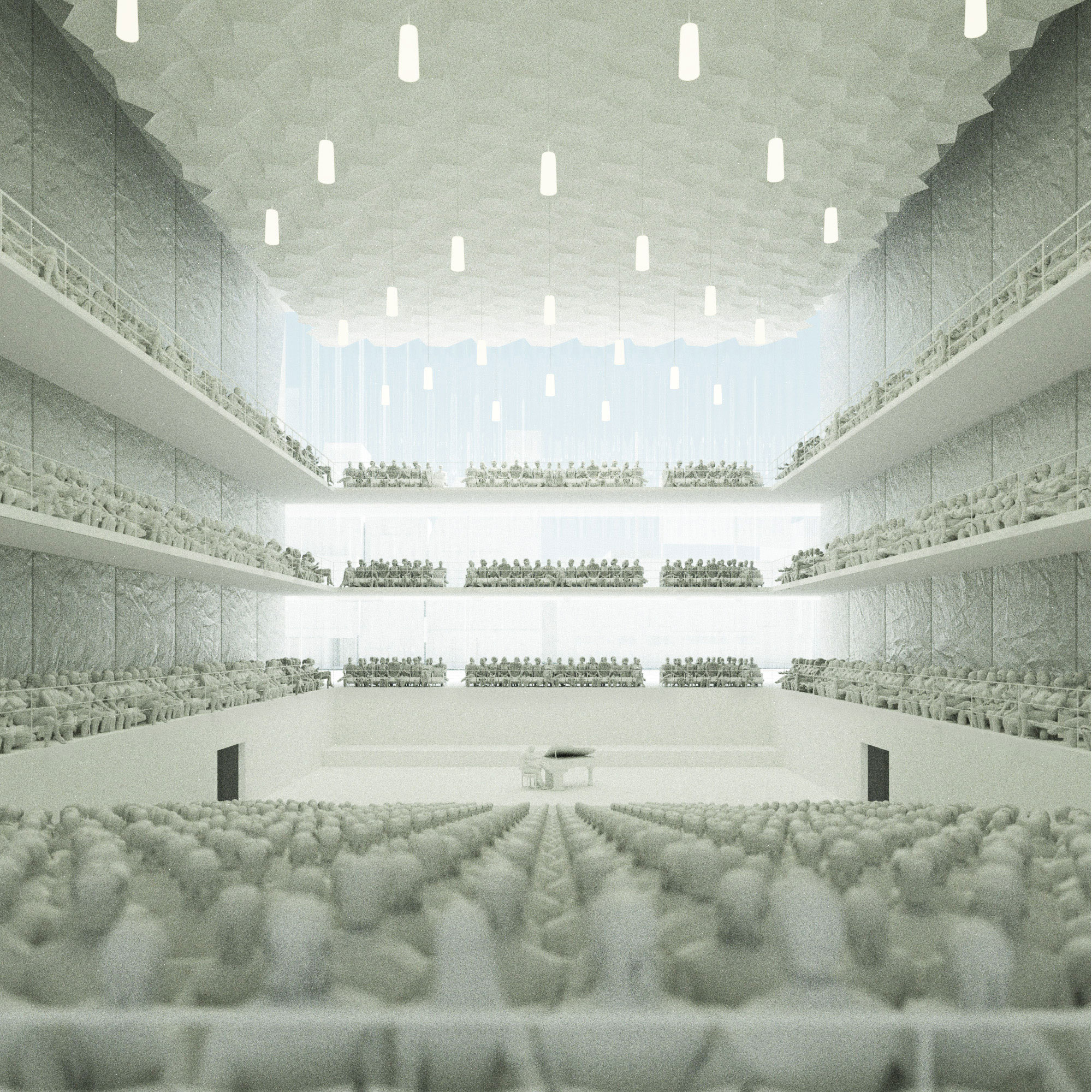
Our proposal is an attempt to remove from the music hall any sense of exclusivity, monumentality, or association with an unapproachable ‘high’ culture. Instead, the concert hall must be accessible and open. To this end, the theatre volume is wrapped in a lightweight, open structure, which allows public spaces such as the restaurant and bar to support the life on the street as well as serving the guests seeing a performance. This type of structure is a contemporary adaptation of traditional Japanese framing typologies, which allow spaces to be selectively indoor or outdoor.
A narrow, one storey pavilion extends the commercial frontage on the north side of TakeshitaDori, and creates a permeable transition into a public square that links Meiji-Dori Street to the Togo Shrine garden path, and to the entrance foyer of the theatre.
The concert hall itself is the classic shoebox shapeof dimensions similar to Boston Symphony Hall (still considered one of the acoustically greatest halls in the world) with three tiers of wraparound balconies. The end wall behind the stage is acoustic glazing, corrugated to diffuse sound, allowing natural light into the hall while presenting the image of the city as a backdrop to the performance. Towards the entrance, the concert hall lobbies on each floor face onto the Togo Shrine park. In addition, the ground level side walls of the theatre are designed to pivot open, creating for certain events a new public relationship between the concert hall and its surroundings. These pivoting panels not only allow for a seamless transition between the plaza and the concert hall, they also help welcome a greater variety of musical genres within the concert hall by creating an open condition which is more acoustically suitable for amplified music.