New School of Jilovsko
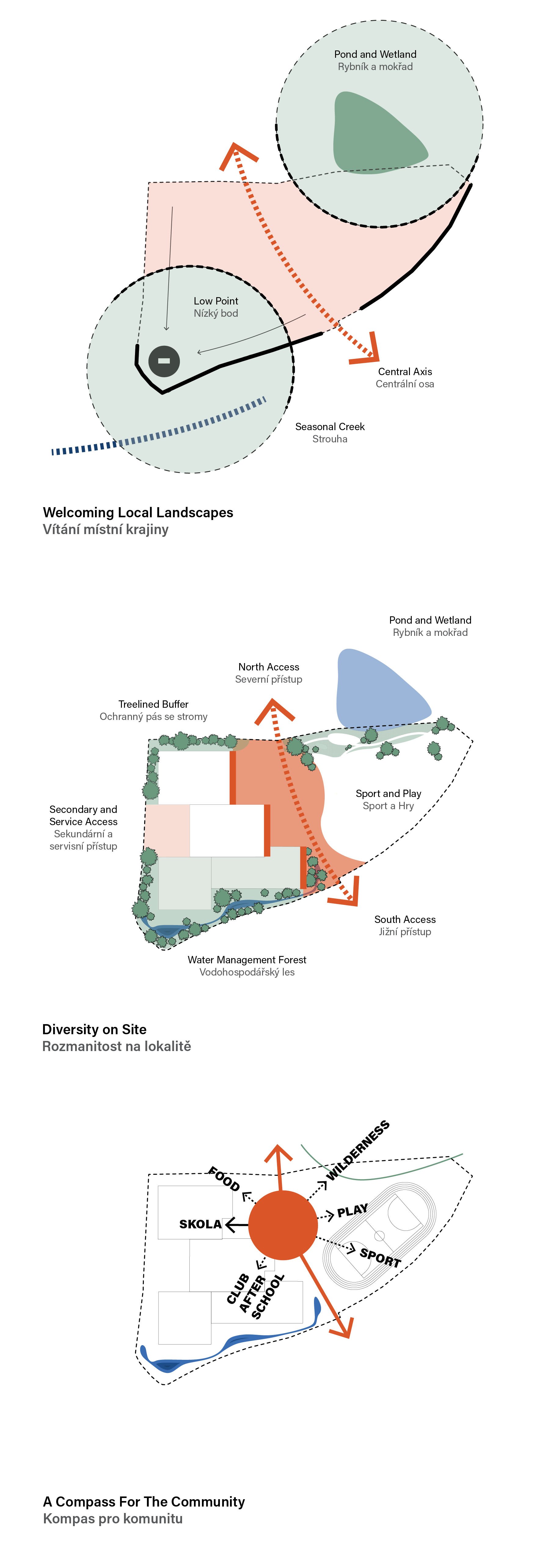
Discovering the richness of our immediate surroundings is the first step in learning about the world. The school is integrated into local ecology. Inviting the forest and natural water management into the site creates a diversity of landscapes.
The heart of the site becomes a node to explore this diversity: spaces to play, explore, exercise, gather, and learn. The school contains a variety of formal and informal, indoor and outdoor, spaces for learning organized around a shared commons.

Location: Jilovsko, Czechia
Status: Competition
Date: 2024
Discovering the richness of our immediate surroundings is the first step in learning about the world. The school is integrated into local ecology. Inviting the forest and natural water management into the site creates a diversity of landscapes. The heart of the site becomes a node to explore this diversity: spaces to play, explore, exercise, gather, and learn. The school contains a variety of formal and informal, indoor and outdoor, spaces for learning organized around a shared commons.
The School of Jílovsko will serve residents of five neighbouring municipalities. This amalgamation will foster new relationships, promote educational excellence, and ensure equal access to high-quality education for all residents. The school will become a central hub for learning and community activity. It will provide a platform for students, parents, and educators from different towns to come together, exchange ideas, and collaborate on educational initiatives. This inclusive approach will create a rich, dynamic, and diverse learning environment, enriching the educational experience beyond Jílovsko.
A central node for the community
The school is centrally located on a public path between important public spaces. The school must embrace its role as a central node that connects residents.
The school site is surrounded by diversity of landscapes: the fields, patches of forest, Sirotčí strouha seasonal creek, the pond, and the Radlík village itself. It is at a connection of two ecological axis - the seasona creek of Sirotčí strouha and the local pond network. The school should act as an ecological connector for the local ecosystem.
Welcoming Local Landscapes
While large portions of the local landscape are used for agriculture, there remain fairly diverse biotopes in the region, from mixed forests to grasslands and wetlands. These biotopes, mapped below (from nature.cz information) can inform the types of landscapes that can come to coexist on site with the school. Based on research and local data, there had been sightings of over one hundred different species within a 2 km radius of the site. These included plants, fungi, birds, amphibians, mammals, reptiles, insects and arachnids. These species predominantly dwelled within riparian, grassland and forest ecosystems. With the proper site and planting strategy, the site itself can become an important connector for wildlife networks and regional ecosystems, allowing children to become stewards of the local ecology.
The site should welcome local landscape typologies, becoming a connector for larger regional networks and habitats: grasslands and wetlands, forests, and productive landscapes.



Four Units
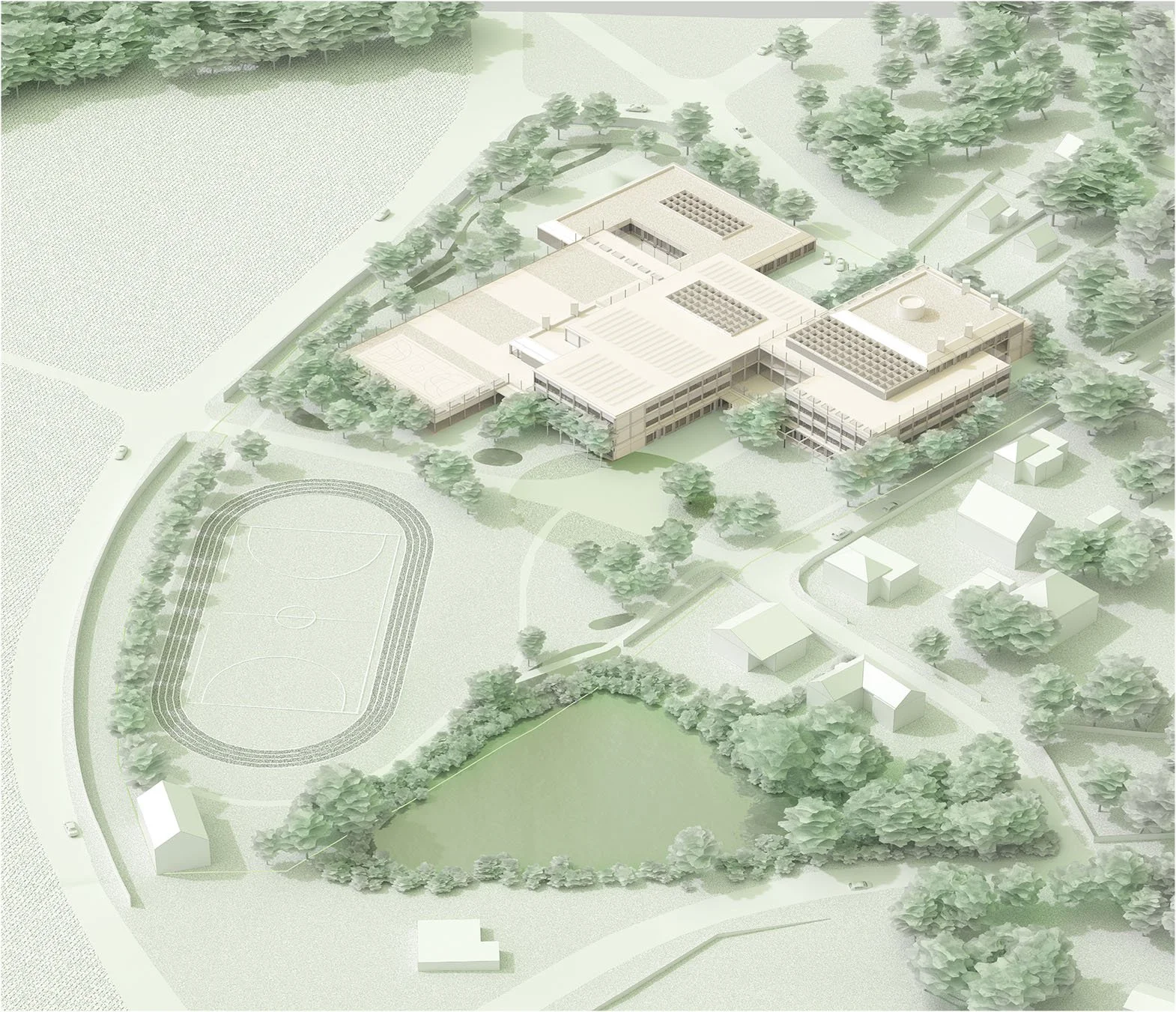
The school is organized into four units. Each unit has a distinct programme, relationship to its context, morphology, height, and expression. Some units are taller than others. Some have accessible green roofs.
Unit 1 is tallest and contains all Tier II classrooms. Unit 2 is of middle height and contains all Tier I classrooms. Unit 3 contains pre-school and school administration. Unit 4 contains the gym.
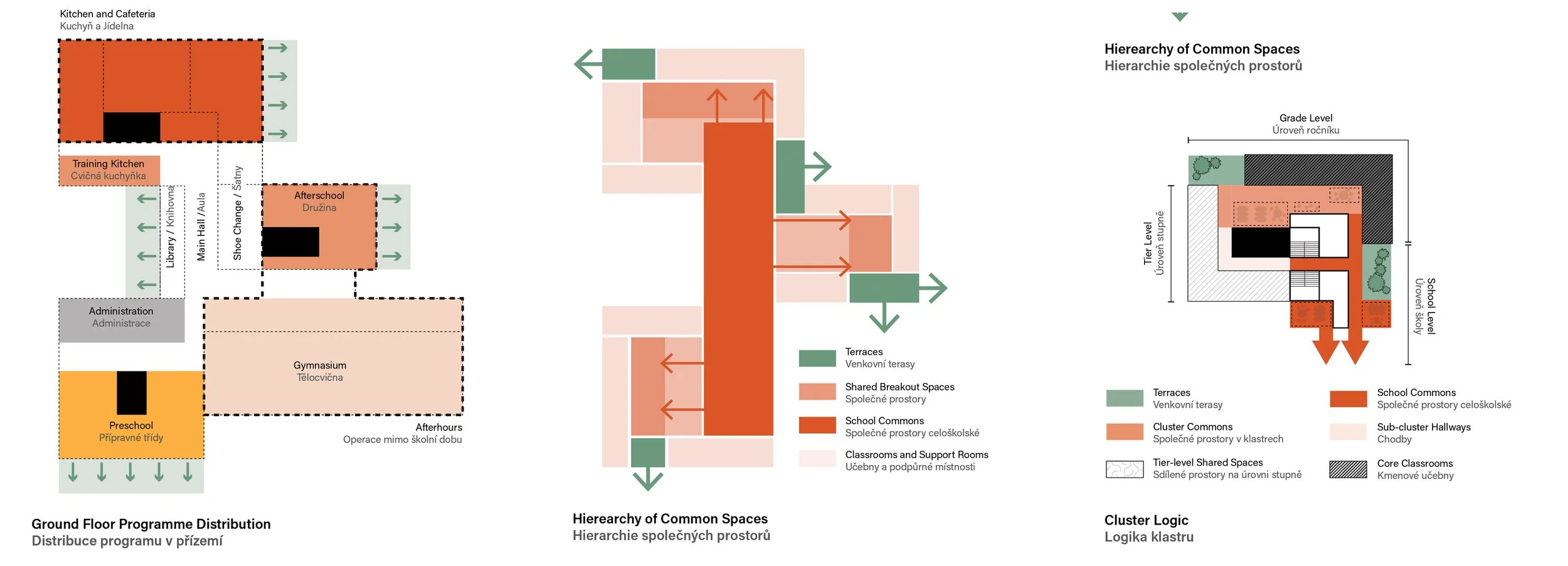
Ground Floor Programme Distribution
On the ground floor the program is distrubuted into different wings. Kitchen and Cafeteria is in Unit 1. Afterschool and Library in Unit 2. Unit 3 contains pre-school and school administration. Unit 4 contains the gym.
The wings of the ground floor connect to the main hall in the centre.
Hierarchy of Spaces
On a typical floor, the programme is organized hierarchically. An atrium shared by the entire school is in the centre of the floorplate. Smaller common spaces, shared by a cluster of classrooms are accessed off of the atrium. Classrooms and other rooms are accessed from these smaller common spaces. Each common space opens onto a terrace.
Each cluster of classrooms contains the following: core classrooms for two grades, specialized classrooms and other rooms shared by an entire tier, washrooms, common spaces, and an outdoor space.



Yeouido Performing Arts Center
A performing arts center and major public park in the heart of Seoul

| Location: | Seoul, South Korea |
|---|---|
| Status: | Competition |
| Date: | 2023 |
There once was a mountain called Yangmal in the northern part of Yeoido Island. There were also grasslands and sandy plains along the river. Before it was cut down to make way for the new parliament building, Yangmalsan was a local landmark, a place for diverse human activities, alternatingly documented as a place for shepherds, for dwelling and for sacred rituals.
We propose creating a hill, a seasonal native landscape that reconnects the surrounding site and the local ecologies from riparian wetlands to forest; an iconic shared space for nature and culture. The hill, an interplay of water, planting and glazed volumes, reminiscent of waterfalls, invites exploration of its terrain, and the discovery of its large halls and hidden performance space, its places for meditation and its major vistas. Performing arts and day-to-day life become an ever-changing layer within the local landscapes.


Jan Vodnansky School: Diversity Nurtures Unique Educational Journeys
The school is a collection of diverse educational opportunities: classrooms, spaces for performance and display, nooks for small gatherings, lounges and playgrounds for group interactions, gardens for growing vegetables and for supporting pollinators and other species. All organized around a central shared atrium.

| Location: | Prague, Czech Republic |
|---|---|
| Status: | Competition Entry |
| Date: | 2022 |
The school is a collection of diverse educational opportunities: classrooms, spaces for performance and display, nooks for small gatherings, lounges and playgrounds for group interactions, gardens for growing vegetables and for supporting pollinators and other species. All organized around a central shared atrium.
Diversity enables children to create their own educational journeys, and grow through sharing the world in their personal, unique way.

Connectivity Through Shared Spaces
The school is structured in a way that creates two interconnected wings of program: The main school wing and the gym, events and support wing:
The main school wing contains all classrooms and central administrative programs, with early education at grade (near the outdoor play area), tier one on the 1st floor, tier two on the 2nd floor and specialized classrooms distributed on the third floor and within the base.
Language classrooms and office spaces are divided equally among all floors. The gym and support wing has the kitchens, loading, cafeteria and individual access at grade, upon which all gyms, lockers and sports fields are located.
This wing can operate independently before and after hours, facilitating not only use by the local community, but also creating a safe loading and food pickup strategy that doesn’t interfere with the day-to-day operations of the school.

Operational Layout
While it is a playful space for creativity and growth, the school is also organized as to maximize efficiency and safe access for both children and staff. Dedicated access is created for younger and older children, while shared spaces, core and specialized classrooms are situated to maximize accessibility.


Goyang City Hall: A Civic Place rooted in Nature and Community
The identity of a city is established through an interaction of local ecology, culture (history), and community. A future oriented, eco-friendly city that empowers its citizens should cherish and nurture connections between its ecology, culture and community.

| Location: | Goyang, South Korea |
|---|---|
| Status: | Competition Entry |
| Date: | 2021 | With: | HLD Landscape, SAC |
The identity of a city is established through an interaction of local ecology, culture (history), and community. A future oriented, eco-friendly city that empowers its citizens should cherish and nurture connections between its ecology, culture and community.
The new Goyang City Hall is located at an intersection of a Hoguk-ro and Daejangcheon. Whereas Hoguk-ro and Goyang-daero are familiar to the people of Goyang, the Daejangcheon was long neglected. The re-naturalized creek improves ecological resilience of natural networks of Goyang-si, and celebrates a connection to local ecology. The new City Hall and the Council buildings frame and activate a Community Plaza, the heart of the site, at the intersection of urban and creek landscape. At the Community Plaza, diverse spatial conditions facilitate a multiplicity of public activities for all of the citizens of Goyang-si.
The City Hall that welcomes the local community to inhabit this intersection between nature and the city is a symbol of a future oriented, eco-friendly city that cherishes its local ecology and empowers its citizens.


Naturalized Landscape
The natural zone is located around the re-naturalized Daejangcheon creek. It consists of an expanded riparian corridor an ecologically important park space, which also becomes a public amenity for the city. The Natural Landscape improves the ecological resilience of the local natural networks of Goyang-si, supporting both local flora and fauna. Its immersive public spaces, where one can reconnect to nature, include large “petal” platforms from which to observe the creek, and invite people to rediscover the beauty and importance of the local landscapes. We hope that the creek renaturalization project can be expanded, creating a longer connective network, with its heart at the new city hall.


Civic Landscape
The Civic Plaza is located along the west side of the site, facing Hoguk-ro and provides access to the city hall, council and future addition buildings. It provides a buffer between the City Hall complex and the busy road. This plaza is also the civic face of the complex, a lush yet structured landscape with ample seating that welcomes visitors and staff alike. The civic plaza is home to a central sunken courtyard to host diverse public events, which connects directly to the auditorium, cultural clubrooms and the underground level. The plaza is purposefully devoid of vehicular drop-offs (located on the other side of the buildings) in order to prioritize pedestrian access.

Community Plaza
The Community Plaza is at the intersection of the Natural and Civic Landscape. It is a diverse, active space connected to all major community and institutional programs of the City Hall complex. The Council space is directly adjacent, and visually opens the Community Plaza, as is the Main Auditorium with Bookstore Cafe, and Community Center. Major public entrances to both buildings are located off of the Community Plaza. Open and covered canopies provide infrastructure for activities in all seasons and weather conditions.

City Hall Building
Goyang’s City Hall is located such that there is a generous civic plaza between the street and building. This allows for various activities of different sizes to occur - whether it be small gatherings or large cultural events. The sunken auditorium, both at the interior and exterior, allows for this flexibility while also maintaining a strong connection to the civic plaza. Public programs such as the community centre, book cafe and libraries similarly connect City Hall with the community plaza to the north. This creates a diverse environment where the building and its inhabitants can activate the plazas. The building is accessed by vehicle via a dropoff zone at the south of the building. South of City Hall there is also a two storey parkade that connects to the two levels of underground parking.
All public program is located within the podium of City Hall. A large staircase in the atrium leads patrons to the a generous lounge on L2, with libraries and the civic petitions centre at either end. More public-oriented programs such as the studio and pressrooms are also situated on L2. From L3 upwards, all floors are private and for staff only. Mayor’s and Director’s offices are all located at L8, where green roof terraces can also be found. Planted terraces throughout the different floors allow for a close connection to nature and promote well being for the staff. In addition to these green spaces, all offices are located around the perimeter of the floor plate to ensure that they have ample access to natural daylight and fresh air. This circular office arrangement also allows for layout flexibiliy as departments change over time, while the circulation cores and meeting spaces remain in place and form a buffer between the open offices and the atrium


Council Building
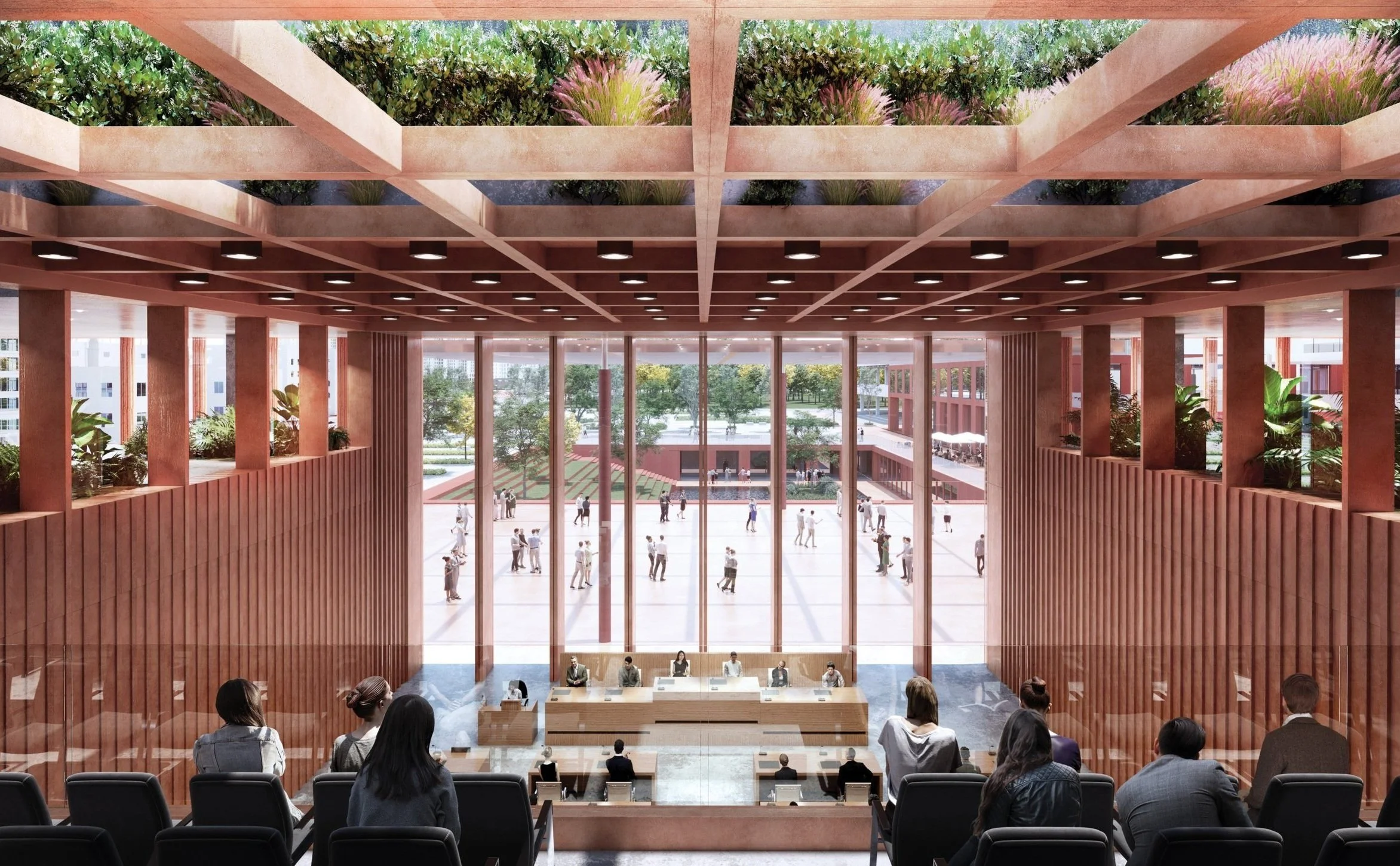
The Council Building’s council chamber faces and activates the community plaza to the south. An audience lounge on Level 2 is accessed via the building’s green atrium, where views are provided to not only the chamber below but also the community plaza beyond. Large doors within the council chamber provide privacy when needed. Levels 2 to 4 contain all required offices and support spaces, and an accessible green roof terrace allows for outdoor staff gatherings. There is a dedicated dropoff area to the north of the building for staff and visitors, and a ramp provides access to the underground parking levels where there is a physical connection with City Hall.