

Goyang City Hall: A Civic Place rooted in Nature and Community
The identity of a city is established through an interaction of local ecology, culture (history), and community. A future oriented, eco-friendly city that empowers its citizens should cherish and nurture connections between its ecology, culture and community.

| Location: | Goyang, South Korea |
|---|---|
| Status: | Competition Entry |
| Date: | 2021 | With: | HLD Landscape, SAC |
The identity of a city is established through an interaction of local ecology, culture (history), and community. A future oriented, eco-friendly city that empowers its citizens should cherish and nurture connections between its ecology, culture and community.
The new Goyang City Hall is located at an intersection of a Hoguk-ro and Daejangcheon. Whereas Hoguk-ro and Goyang-daero are familiar to the people of Goyang, the Daejangcheon was long neglected. The re-naturalized creek improves ecological resilience of natural networks of Goyang-si, and celebrates a connection to local ecology. The new City Hall and the Council buildings frame and activate a Community Plaza, the heart of the site, at the intersection of urban and creek landscape. At the Community Plaza, diverse spatial conditions facilitate a multiplicity of public activities for all of the citizens of Goyang-si.
The City Hall that welcomes the local community to inhabit this intersection between nature and the city is a symbol of a future oriented, eco-friendly city that cherishes its local ecology and empowers its citizens.


Naturalized Landscape
The natural zone is located around the re-naturalized Daejangcheon creek. It consists of an expanded riparian corridor an ecologically important park space, which also becomes a public amenity for the city. The Natural Landscape improves the ecological resilience of the local natural networks of Goyang-si, supporting both local flora and fauna. Its immersive public spaces, where one can reconnect to nature, include large “petal” platforms from which to observe the creek, and invite people to rediscover the beauty and importance of the local landscapes. We hope that the creek renaturalization project can be expanded, creating a longer connective network, with its heart at the new city hall.


Civic Landscape
The Civic Plaza is located along the west side of the site, facing Hoguk-ro and provides access to the city hall, council and future addition buildings. It provides a buffer between the City Hall complex and the busy road. This plaza is also the civic face of the complex, a lush yet structured landscape with ample seating that welcomes visitors and staff alike. The civic plaza is home to a central sunken courtyard to host diverse public events, which connects directly to the auditorium, cultural clubrooms and the underground level. The plaza is purposefully devoid of vehicular drop-offs (located on the other side of the buildings) in order to prioritize pedestrian access.

Community Plaza
The Community Plaza is at the intersection of the Natural and Civic Landscape. It is a diverse, active space connected to all major community and institutional programs of the City Hall complex. The Council space is directly adjacent, and visually opens the Community Plaza, as is the Main Auditorium with Bookstore Cafe, and Community Center. Major public entrances to both buildings are located off of the Community Plaza. Open and covered canopies provide infrastructure for activities in all seasons and weather conditions.

City Hall Building
Goyang’s City Hall is located such that there is a generous civic plaza between the street and building. This allows for various activities of different sizes to occur - whether it be small gatherings or large cultural events. The sunken auditorium, both at the interior and exterior, allows for this flexibility while also maintaining a strong connection to the civic plaza. Public programs such as the community centre, book cafe and libraries similarly connect City Hall with the community plaza to the north. This creates a diverse environment where the building and its inhabitants can activate the plazas. The building is accessed by vehicle via a dropoff zone at the south of the building. South of City Hall there is also a two storey parkade that connects to the two levels of underground parking.
All public program is located within the podium of City Hall. A large staircase in the atrium leads patrons to the a generous lounge on L2, with libraries and the civic petitions centre at either end. More public-oriented programs such as the studio and pressrooms are also situated on L2. From L3 upwards, all floors are private and for staff only. Mayor’s and Director’s offices are all located at L8, where green roof terraces can also be found. Planted terraces throughout the different floors allow for a close connection to nature and promote well being for the staff. In addition to these green spaces, all offices are located around the perimeter of the floor plate to ensure that they have ample access to natural daylight and fresh air. This circular office arrangement also allows for layout flexibiliy as departments change over time, while the circulation cores and meeting spaces remain in place and form a buffer between the open offices and the atrium


Council Building
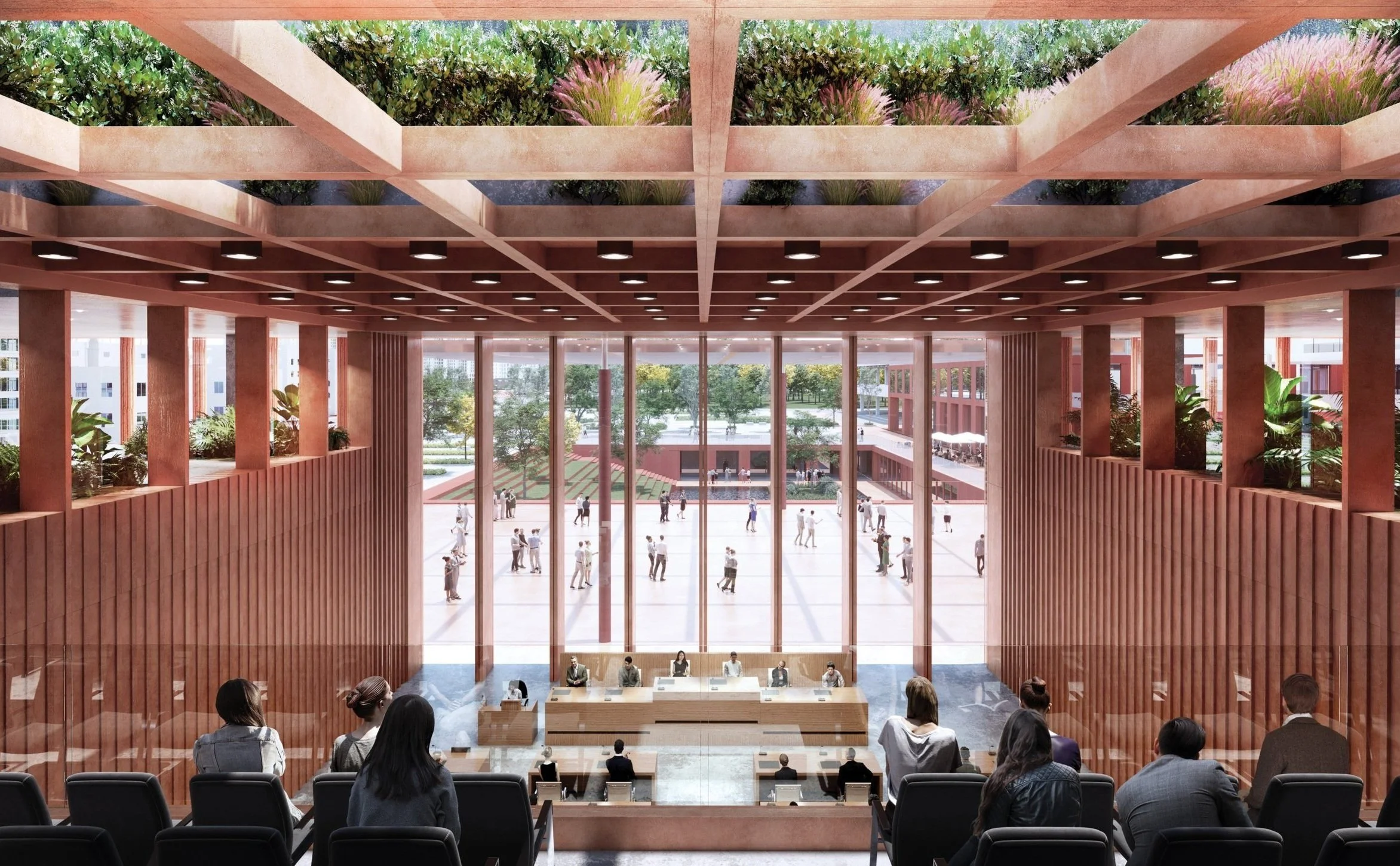
The Council Building’s council chamber faces and activates the community plaza to the south. An audience lounge on Level 2 is accessed via the building’s green atrium, where views are provided to not only the chamber below but also the community plaza beyond. Large doors within the council chamber provide privacy when needed. Levels 2 to 4 contain all required offices and support spaces, and an accessible green roof terrace allows for outdoor staff gatherings. There is a dedicated dropoff area to the north of the building for staff and visitors, and a ramp provides access to the underground parking levels where there is a physical connection with City Hall.


Jeju Island Jusangjeolli Living Heritage
Designed in collaboration with South Korean landscape architecture office HLD, this proposal was the runner-up in an invited competition to redesign the visitor experience at one of Jeju Island’s most characteristic natural heritage sites.
| Location: | Jeju Island, South Korea |
|---|---|
| Status: | Competition Runner-up |
| Date: | 2018 |
| With: | HLD Landscape |
Designed in collaboration with South Korean landscape architecture office HLD, this invited competition proposal tells the many-layered story of one of Jeju Island’s most important heritage sites, the Jusangjeolli columnar jointing area, where a forest of polygonal basalt columns formed when molten lava flowed into the sea and cooled under particular conditions. Through a mix of evocative landscaped zones, and a set of complimentary pavilions, the project reveals the history of the spectacular geological formations, the island’s volcanic origins, its pine forests and ancient mythology, local fishing traditions and agricultural practices, recent scientific research, and the impact tourism culture.
Vistors to the park would move through a series of highly evocative landscapes. Fields of volcanic gravel related to the area’s famous dry-stone windbreak walls. Agricultural areas, planted in resilient native species of coastal meadow, would tell of the history of the islands agricultural practices and settlement patterns. In other areas, soil is scraped away to reveal the underlying volcanic clinker, displaying the flow of magma from a nearby volcanic cone. Near the coastline, where there is enough soil, the island’s characteristic pine trees are re-established. All these landscapes are supported by a set of complimentary pavilions, which offer places of rest and shelter, or exposure and adventure, infrastructure for practical use, and places to gather.


Viewing Platforms
Lightweight platforms made of stainless steel grating over rough clinker, and textured concrete on flatter ground, expand the experience of visitors right up to the edge of the basalt formations, and create opportunities to gather in groups as well as enjoy the view in solitude.


Cultural Experience Zone
Further inland, the relationship between the island’s geology and centuries of human inhabitation is revealed, in an partly sunken pavilion that provides a gather space for public talks and performances.


Geological Exploration Zone
At the site’s eastern gateway, a ranger pavilion with a rooftop lookout provides a base for park staff, sho will provide guided tours of the site’s more sensitive areas.


Wave Cove
Where the ocean waves meet a cove in the cliffs, they are focused into an impressive spray of water, which is further amplified by the polished concrete canopy of the wave cove. The experience here focuses on the lives of the Haenyeo, the women divers of Jeju Island, who dive without oxygen tank, well into their 80’s, to gather shellfish like abalone and urchins.


Neobaegii Market:
Over the years, the park has provided a space for local villagers to sell their crafts and produce. A set of market pavilions at the park entrance, in close proximity to the ticket and information stations, provide a permanent link between the villagers and the park. These pavilions are inspired by the informal market stalls found all over South Korea, providing lockable storage space, plumbing and electricity, and a lightweight roof.

The site pavilions are a cohesive family with a similar construction logic, but depending on the location will have different material character.
See the full competition panels:

Gukhoe Daero
| Location: | Seoul, South Korea |
|---|---|
| Status: | Competition 3rd Place |
| Date: | 2019 |

Gukhoe-daero park leads directly to the National Assembly Building; it should represent the future of healthy and resilient city building. A 21st century park must generate value on multiple levels, socially, environmentally and economically. It must address the future of cities in terms of ecological resilience, the needs of populations in terms of health, sustenance and recreation, and needs to be flexible and multi-functional from a productive point of view. A new linear park on Gukhoe-Daero can also help bring together disconnected urban communities, ecological areas and people.
What is the DNA of such a healthy city? We believe that it is composed of three “strands”, each associated with a type of space:
1) Productive spaces
2) Active space
3) Wild spaces
Only when these three strands are brought together can citizens live healthy, active lives.


A Family of Landscapes: LH Daejang Town Masterplan

| Location: | Daejang, South Korea |
|---|---|
| Status: | Honourable Mention, Competition 3rd Place |
| Date: | 2020 |
| With: | SAC International |
Bucheon-Daejang area, located within the greenbelt of Seoul, is surrounded by diverse landscapes. Mountains to the south. Agricultural fields to the north, Gulpo creek to its east (and several smaller creeks running through it): Landscapes define the experience of the site.
The new town should be conceived as an articulation of (rather than erasure of) existing landscape, securing and strengthening its ecological function and fostering the creation of human communities within it. Creating a city that enhances biodiversity, and ecological strength of the landscape, will also foster a new kind of resilient human community.
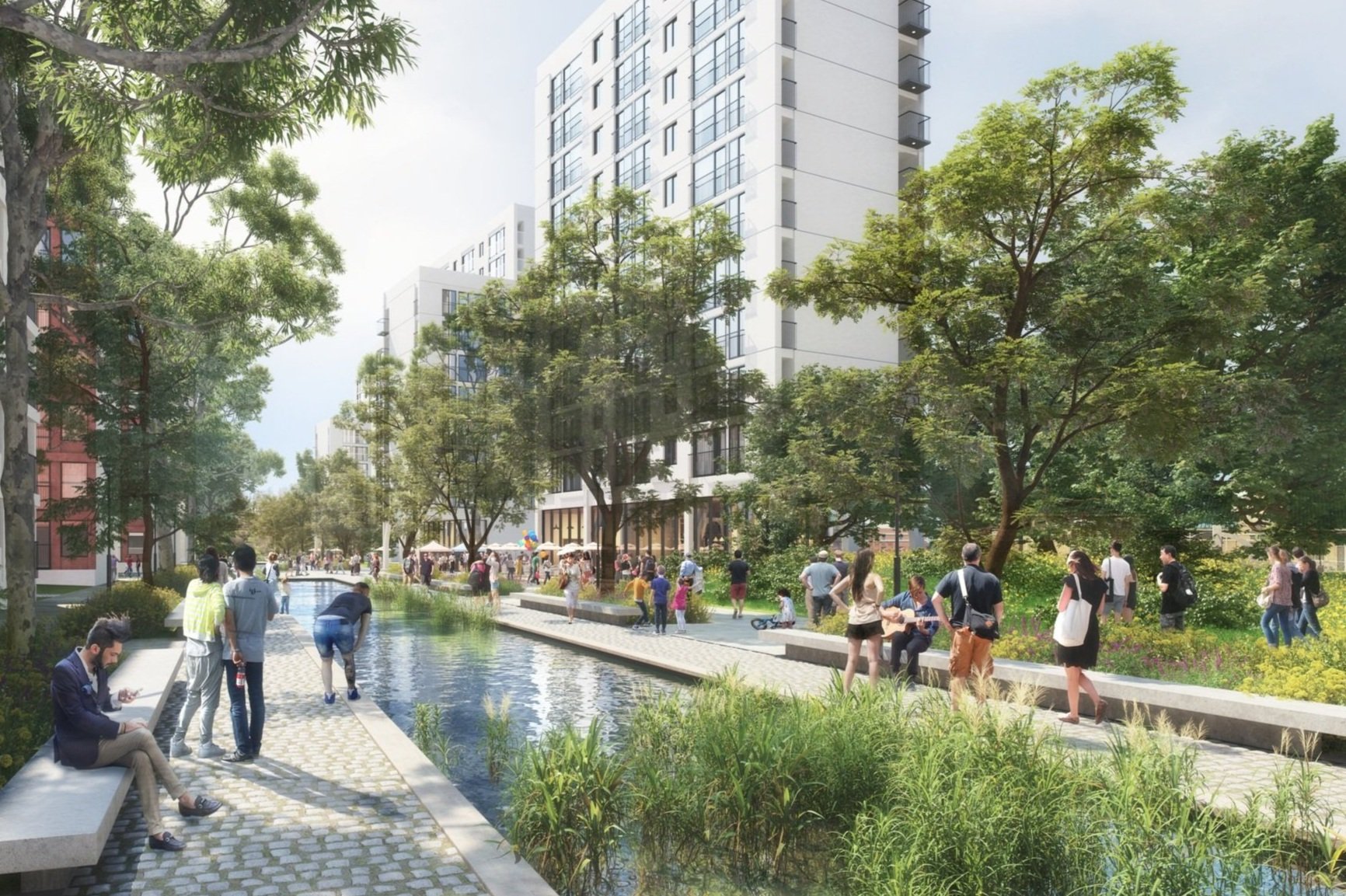
Our proposal creates a hierarchy of landscapes, ranging from big nature corridors that perform the most important ecological and hydrological functions, active corridors containing sports fields, schools, and urban agriculture, ecological neighbourhood streetscapes, which combine transportation and ecological infrastructure, to intimate communal courtyards and pocket spaces.
The scale of landscape relates to the scale of the human community. The big nature serves the entire Bucheon-Daejang town. Each active corridor serves one district. Ecological streets serve a neighbourhood, and courtyards are shared with one’s immediate neighbours.
At each scale/layer/level the landscapes perform an ecological and hydrological function, a productive function - providing food, clean air, energy and carbon sequestration, they provide a connection to nature. By foregrounding the ecological, productive, and natural processes, the project also fosters new kinds of connections between the people and creates new resilient communities.
As one traverses outward from the apartment unit, the unit of engagement expands from one’s family, then to a collection of families, neighbours, who share a courtyard, to an entire neighbourhood that is a collective of courtyards. Multiple neighbourhoods comprise a district, sharing an Active Corridor. Finally, the Big Nature corridors are shared by the entire community of Bucheon-Daejang.
The hierarchy of landscapes is akin to a biological family, with each layer setting the stage for the next. It marks a continuum and mirrors the passage of a human's journey into and with the world. The innermost section, the Courtyards, embodies a sense of intimacy, enclosure and safety like an embrace as if to provide a shelter for an infant to begin the early steps into the world. The neighbourhood is a familiar and safe world for a child. While active corridors at the heart of each district facilitate diverse activities for young adults. Finally, the forests and creeks in the big nature corridors are like a wise mature adult.
As the landscape expands and opens up its physical presence, it breathes energy into the human engagement with the world as individuals and as a community, first with one's family, then with a neighbourhood, a community, then the world.

“Family of Landscapes” concept diagram

Masterplan

Masterplan morphology diagrams

Active corridor

“Big Nature” Corridor at SBRT Node


Neighbourhood square in Pilot Village

Ecological promenade and commercial zone section

Ecological promenade and commercial zone plan

Ecological promenade and commercial zone View