Ada Park: Mixed-Use Community
Belgrade’s identity, ecosystems and history are defined by its relationship to the Danube and Sava rivers.
Ada Park will set a new precedent for sustainable and resilient development along Belgrade’s rivers, embracing old and new ways to engage with its landscapes in day-to-day life.

| Location: | Belgrade, Serbia |
|---|---|
| Status: | Study submitted |
| Date: | 2024 |
Belgrade’s identity, ecosystems and history are defined by its relationship to the Danube and Sava rivers.
Ada park will set a new precedent for sustainable and resilient development along Belgrade’s rivers, embracing old and new ways to engage with its landscapes in day-to-day life. Ada Park combines office, residential, commercial programming, around transit-connected public spaces. It is place of business (Negotium) and of leasure (Otium), where urban fabric and local landscapes support one-another.


The site of future Ada Park is located at an intersection of two major regional transects: (1) the Sava River valley edge, and (2) the Belgrade suburban transition.
Sava River Valley Edge
Belgrade’s identity, ecosystems and history are defined by its relationship to the Danube and Sava Rivers, and the conditions of the river valley edge. On the lower part of its course, near its confluence with Danube, the Sava flow through a wide valley bounded on the south by forested slopes of Banovo Brdo, and extending far to the north. Tradionally, for vast majority of its history, the site was identified by its location within Sava River valley. The site is located near the bottom of the river valley, within a floodplain forest below the mesic forest of Banovo Brdo. Before 20th century, the spatial character and its inhabitation was determined entirely by the river valley transect.
Belgrade Suburban Transition
As the city of Belgrade expanded in the second half of 20th century, the site found itself in the transition zone between the rural and urban landscape. Today the site is situation at the precise point where the rural landscape ends and suburban landscape begins. The site is therefore equally defined by its location at the entrance to the city. It has become a gateway into Belgrade.
Both the river valley transect and the rurar-urban transition define the character and the unique opportunities of the site as it is today. The project should take advantage of the extremely unique condition that the site provides.


416 Park and Memorial
Beyond the water, a forest of tall trees stands out even from a distance. Below these trees, twinkling lights, and a solemn space to gather and commemorate the tragedy of the Sewol Ferry. This is the first scenery that people who visit 416 park will encounter.

| Location: | Asan, South Korea |
|---|---|
| Status: | Competition Entry |
| Date: | 2021 | With: | HLD Landscape |
Beyond the water, a forest of tall trees stands out even from a distance. Below these trees, twinkling lights, and a solemn space to gather and commemorate the tragedy of the Sewol Ferry. This is the first scenery that people who visit 416 park will encounter.
The Sewol ferry disaster touched all of Korean society. 416 park will welcome people so that they may commemorate the victims of the tragedy, and find hope and support in the midst of sorrow. There are still many questions that remain unanswered about the ferry disaster, and 416 park must also be a place to gain understanding and find answers to these questions. 416 park is a place with many different identities: a place of mourning and commemoration, a place of learning and solidarity, and a place to cherish life and live each day with hope in our hearts.
The twinkling lights in the forest lead to a space with stone slabs that symbolize all the anonymous citizens who participate in the remembrance process. This is a collective memory space that invites all to reflect upon the events of 4/16. Glass blocks placed between the stones transmit warm sunlight to the space where the 250 of the victims from Danwon High School are laid to rest. Light shines down into the underground, illuminating a place for more inward remembrance, away from the crowds, and when the evening twilight sets, 304 points of light shine into the night.

The stone slabs of the collective memory space


Light shines from above, into the space of remembrance
Spaces of solidarity and spaces of remembrance
The park has many roles to play: it must support mourning, commemoration, learning, healing, and finally the day-to-day life of the local community. These roles must coexist without conflict. Certain roles require dedicated spaces, a singular place of remembrance and enshrinement, a place with amenities for community building and support, etc… These spaces have distinct identities, but are connected through a pathway that also provides access to the the exhibition and documentation spaces.


All facilities on site function independently while being connected. Mostly underground, the community and exhibition spaces have a subdued expression.
A subdued yet inviting community center and office pavillion, is located to the south, above the storehouse for ease of loading and access. Connected to this building, but publicly accessible from the central ramp, the exhibition space and large multi-purpose hall provide a different experience. These are also conveniently located adjacent to the storehouse.
The Exhibition Spaces
The exhibition lobby is accessed from the ramp that leads to the commemoration spaces. Upon entering, visitors can access the multi-purpose hall at the same level, or proceed to the exhibition spaces located underground (at the same level as the storehouse). Permanent and special exhibition spaces are located across from each other around a central courtyard, allowing each to have its own procession.
Nature and life permeate almost all spaces on site, whether it be through light, forests or water. The exhibition building follows that thread by having at its core a vegetated courtyard, around which major circulation is structured. It is a way to bring light down and anchor an element of life into a place that not only educates visitors about a tragedy, but also commemorates the life of the victims.
The Community Plaza
Unlike the exhibition and commemoration components of the site, the community center, along with its surrounding landscape should foster a sense of welcoming and inclusion. It is a place that provides ongoing support to the local community and should feel warm and comfortable rather than iconic and monumental. The community center prioritizes horizontality, maximizing connections to the plazas and forest that surround it. It disappears from view as visitors descend along the path that leads to the exhibition and commemoration spaces.

Taksim Belongs to Everyone: Cultivating Spaces for Pluralism

| Location: | Istanbul, Turkey |
|---|---|
| Status: | Competition Finalist |
| Date: | 2020 |
Diversity is at the core of Instanbul's identity. Connecting Europe and Asia, Istanbul has always been one of the most internationally diverse cities; a global hub gathering people, and goods from all over the world.
Diversity is also at the core of Taksim's identity. As the modern, post-Ottoman, centre of Istanbul, Taksim is surrounded by monuments representing diverse beliefs, cultures, and ideas. Once a Greek-Armenian neighbourhood on the outskirts of the city, it was also a symbolic space of Kemalism and Modernism, a tourist destination, and a centre for Istanbul's alternative subcultures.
Methodology for Cultivating a Space for Pluralism:
Diversity is the identity of Taksim, and Istanbul. Pluralism is the explicit valuing of diversity as such. A pluralist space encourages everyone to maintain their independent cultural traditions, while at the same time including them in the overall collective.
The proposal would cultivate a pluralist space through following four aims:
Step 1
Already existing differences and identities need to be recognized, and the integrity of these identities should be preserved and enhanced.
Step 2
The Commons, a shared space where differences can be negotiated, must be clearly defined and delieneated. The Commons are a basic infrastructure for human life. They need to be accessible, and safe for everyone.
Step 3
Wherever possible, the shared commons should be enhanced in order to supported further diversity.
Step 4
Finally, the inclusion of others needs to be facilitated. Procedures encouraging inclusivity are established.

Historical Monuments of Taksim

Layers of Infrastructure for Pluralism

Masterplan - An Eclectic Scenario
Taksim Belongs to Everyone:
Taksim Gezi Park is in the southernmost green patch of the Bosphorus Green System, a system of parks that is traditionally called “koru”. The korus has situated along with Bosphorus and serves for local and immigrant fauna as well as flora.
Historic Istanbul has been surrounded by cemeteries and gardens providing fresh food for the city. Today, only a few of the gardens have been remained.
As the Gezi Park was a cemetery in past, and redeveloped as an urban park. It is still one of the most crucial green spaces within the dense urban development of Istanbul for its citizens and visitors. Its historic role of water distribution benefiting from its situation on the top of ridge-line highlights its critical role as a urban infrastructure and provision as well as opportunities to foster the ecological flows penetrating city and towards the Marmara Sea in South.

Axo of market and transport hub building

Market and Transport Hub Entrance

Taksim Square

Taksim Square at night

Pedestrian Boulevard leading to Maksem Plaza

Pedestrian Boulevard

TRK Winery
The client is interested in creating a winery that provides visitors a unique experience, a way to feel engaged in the wine-making process. This winery will not cater to large tour groups, but instead welcome smaller groups of visitors that would like to learn and even take part in the life of a vineyard.
The winery will also include a small inn to provide accommodation to visitors to allow them to dwell on site longer and properly experience the daily processes of the winery.
Location: Niagara-on-the-Lake, Canada
Status: Planning
Date: 2018
The client is interested in creating a winery that provides visitors a unique experience, a way to feel engaged in the wine-making process. This winery will not cater to large tour groups, but instead welcome smaller groups of visitors that would like to learn and even take part in the life of a vineyard.
This winery will include a range of different spaces, from productive areas (fermentation room, barrel room, bottle storage room, lab, etc...), educational spaces (conference rooms, seminar rooms, tasting room), and commercial spaces including a small bistro and store. It will also include a small inn to provide accommodation to visitors to allow them to dwell on site longer and properly experience the daily processes of the winery.


In order to do that, we’ve designed a building that engages the surrounding productive landscapes, directly linking the vineyards to the internal processing spaces of the building. As visitors explore the winery they are able to gain an under- standing of the wine-making process and of the landscapes that support it (the grapevines, the supporting pollinator species and indicator species).
The project will be split into three different phases. Phase 1 will include construction of the main production space and a small commercial area. Phase 2 will add the educational facilities, and extend the production area. Phase 3 will add the inn component of the project and a distillery.
The first phase of the project is due to be completed in 2018.

Creemore House
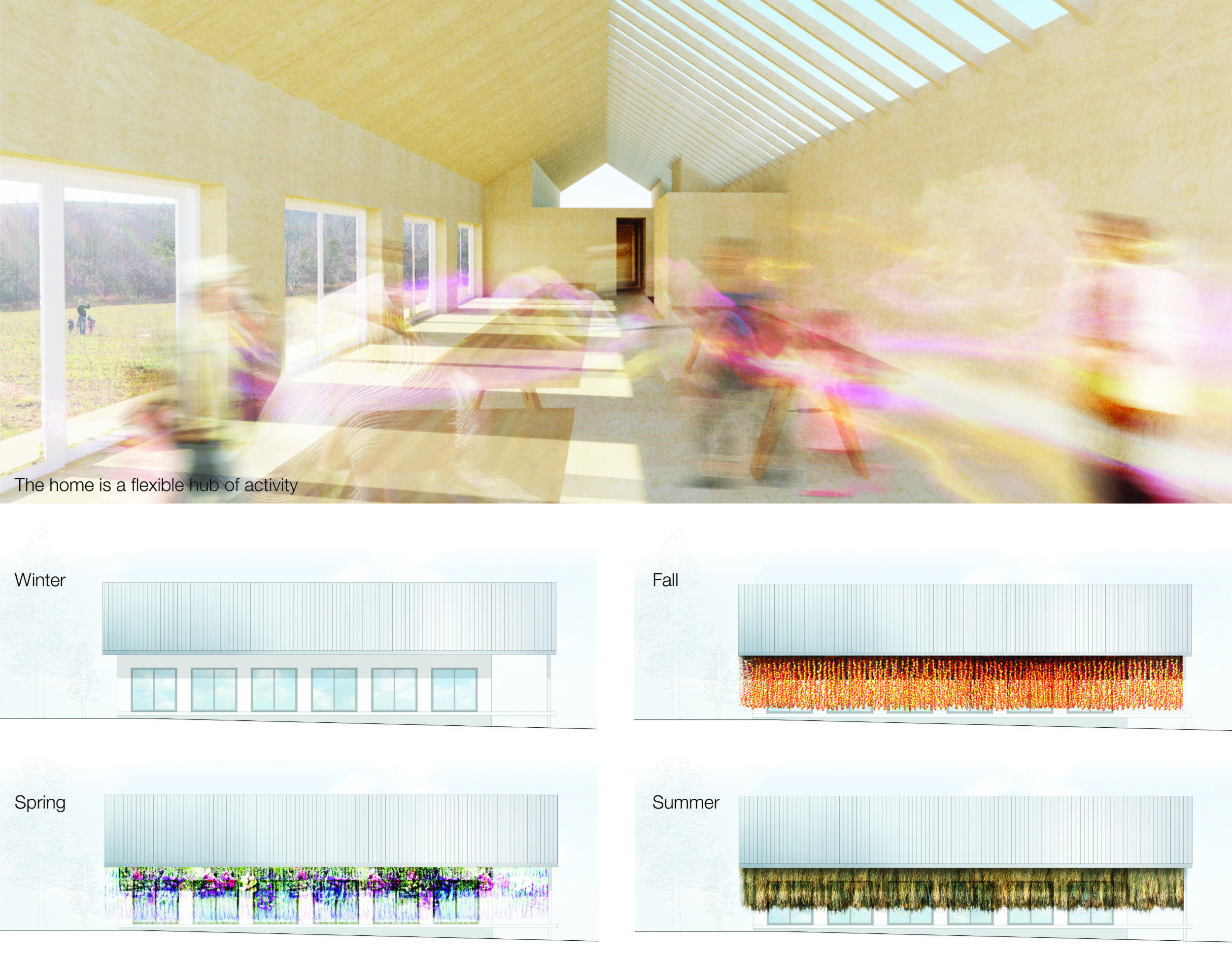
The clients acquired a 5 ha piece of land near Creemore with a dream of living on a site where they can grow their own food as well as processing it into different types of preserves, dry goods and cooked dishes. We designed their home as a flexible productive hub, a place whose identity changes with the seasons, and the agricultural and culinary activities associated with different times of the year.

| Location: | Creemore, Ontario |
|---|---|
| Status: | Construction |
| Date: | 2018 |
The clients acquired a 5 ha piece of land near Creemore with a dream of living on a site where they can grow their own food as well as processing it into different types of preserves, dry goods and cooked dishes. We designed their home as a flexible productive hub, a place whose identity changes with the seasons, and the agricultural and culinary activities associated with different times of the year.
The house has a large flexible interior, an east-facing patio for processing crops, and large overhangs on the South side equipped with a hanging system to dry all kinds of site-harvested foods including persimmons, wild flowers, radishes, cattails, wild rice, etc... Most drying activities take place during spring, summer and fall, taking optimal advantage of the southward exposure of the house.
During the winter, when the sun is lower in the sky, the facade is not used for drying any produce, letting the sun shine far into the house, passively warming it.
This house is another foray into the use of straw as insulative material, and the building envelope reaches R-values of 45-50 through the use of 16” thick walls made of locally harvested straw.